A Complete Guide for Visa and Permanent Residence Applicants
Applying for a Canadian visa or permanent residence often requires applicants to submit several forms and supporting documents. In some situations, you may also choose or be asked to include a Letter of Explanation (LOE) to provide additional information about your application.
A well-written Letter of Explanation can help clarify details that may not be obvious from your application documents. However, it should not be used to replace missing documents or provide misleading information.
If you are wondering how to prepare a Letter of Explanation Canada immigration officers can easily understand, this guide explains its purpose, when it may be useful, and how to write one effectively.
What Is a Letter of Explanation (LOE)?
A Letter of Explanation is a written document that gives additional context about your immigration application.
Its purpose is to explain information that may require clarification, provide background where appropriate, or help immigration officers better understand certain aspects of your application.
An LOE should always be truthful, clear, and supported by evidence where necessary.
Is a Letter of Explanation Mandatory?
Not always.
Many applicants successfully submit immigration applications without an LOE.
However, a Letter of Explanation may be useful when you need to clarify information that could otherwise create confusion during the assessment of your application.
Always follow the instructions provided for your specific immigration program.
When Should You Include an LOE?
A Letter of Explanation may be appropriate in situations such as:
- Explaining gaps in employment or education.
- Clarifying differences in names or documents.
- Providing context for missing documents when permitted.
- Explaining unique personal circumstances.
- Clarifying travel history or other relevant information.
Every application is different, so an LOE should only address information that genuinely requires explanation.
What Should an LOE Include?
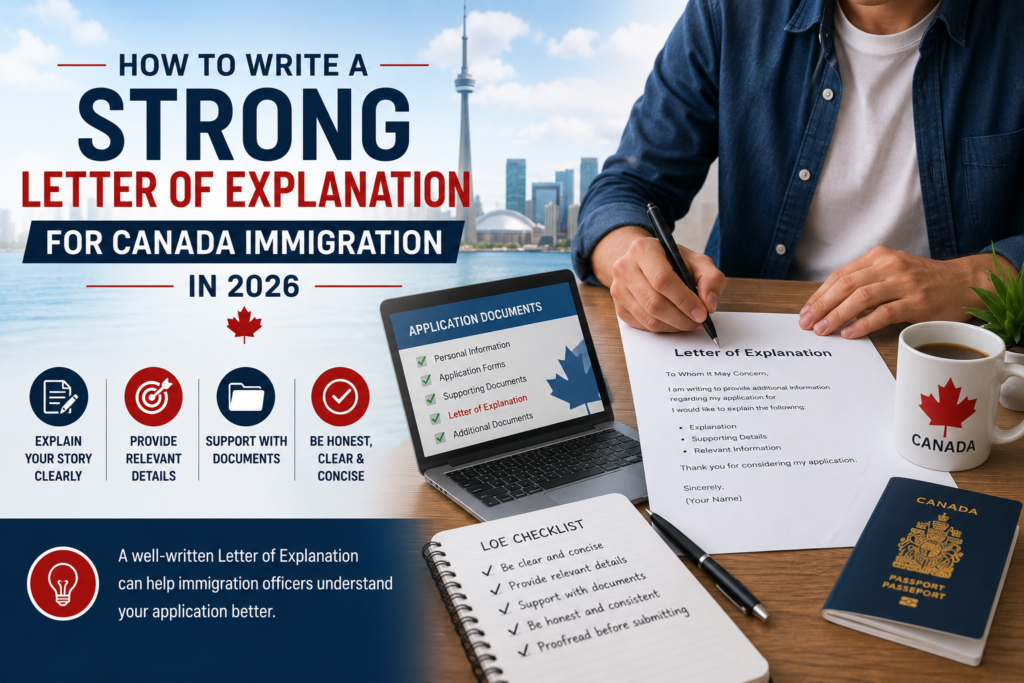
A strong Letter of Explanation should generally include:
- Your full name.
- Your application details, where applicable.
- A clear explanation of the issue.
- Accurate and truthful information.
- References to supporting documents when relevant.
- A polite and professional closing.
The letter should remain focused on facts rather than emotion.
Keep the Letter Clear and Concise
Immigration officers review many applications.
A lengthy letter that includes unnecessary information may make your application more difficult to review.
Instead:
- Use simple language.
- Organize your points logically.
- Address only relevant issues.
- Avoid repeating information already contained in your application.
A concise letter is often more effective than a lengthy one.
Support Your Explanation with Evidence
Whenever possible, your explanation should be supported by appropriate documentation.
For example, if you explain a gap in employment, include any available supporting evidence if required or permitted.
An explanation alone may not be sufficient when official documents are expected.
Common Mistakes to Avoid
Many applicants weaken their Letter of Explanation by making avoidable mistakes.
Common examples include:
- Providing inaccurate information.
- Including unnecessary personal stories.
- Writing an overly long letter.
- Contradicting information elsewhere in the application.
- Using emotional language instead of factual explanations.
- Attempting to justify missing required documents without following official instructions.
Accuracy and consistency are essential.
Tips for Writing a Strong LOE
To prepare a professional Letter of Explanation:
- Be honest throughout the letter.
- Keep your explanations factual.
- Organize your information clearly.
- Check for spelling and grammar mistakes.
- Review the letter before submitting it.
- Ensure it matches the information in your application.
A well-organized letter can make it easier for immigration officers to understand your circumstances.
Can an LOE Guarantee Approval?
No.
A Letter of Explanation is only one part of your immigration application.
Submitting an LOE does not guarantee that your application will be approved.
Immigration officers assess every application according to Canadian immigration laws, program requirements, and the supporting evidence provided.
Why Professional Guidance Can Help
Preparing an immigration application often involves multiple documents, forms, and supporting evidence.
Professional guidance may help applicants:
- Understand when an LOE is appropriate.
- Organize supporting documents.
- Prepare clear and accurate explanations.
- Avoid common application mistakes.
- Better understand immigration requirements.
Reliable advice can help improve the overall quality of your application.
Final Thoughts
A well-prepared Letter of Explanation Canada applicants submit can provide valuable context when additional clarification is needed. While it is not required for every application, an LOE can help immigration officers understand your circumstances more clearly when it is truthful, concise, and supported by appropriate documentation.
Before submitting your application, review your Letter of Explanation carefully to ensure it is accurate, professional, and consistent with the rest of your application.
Need Help with Your Canada Immigration Application?
Worldbridge Immigration helps individuals and families prepare complete Canadian immigration applications, organize supporting documents, and understand the requirements for different immigration pathways.
Whether you are applying for a visitor visa, study permit, work permit, or permanent residence, our experienced team is ready to guide you through every step of the process.