A Complete Guide for Newcomers and Job Seekers in Canada
Finding a job in Canada begins with a strong resume. Even if you have years of experience or impressive qualifications, your application may not receive much attention if your resume does not meet Canadian employers’ expectations.
Many newcomers discover that resumes commonly used in their home countries differ significantly from the format preferred in Canada. Understanding these differences can improve your chances of securing interviews and moving closer to your career goals.
In this guide, you’ll learn how to prepare a Canadian-style resume, what information to include, common mistakes to avoid, and practical tips to help your application stand out.
What Is a Canadian-Style Resume?
A Canadian-style resume is a professional document that summarizes your education, work experience, skills, and achievements in a format commonly expected by Canadian employers.
The goal is to present relevant information clearly and concisely, making it easy for hiring managers to assess your qualifications.
Rather than listing every job you have ever held, a Canadian-style resume focuses on experience and skills that are most relevant to the position you are applying for.
Why Your Resume Matters
Your resume is often your first opportunity to make a positive impression.
Employers may use it to evaluate whether your qualifications match the requirements of the position before deciding whether to invite you for an interview.
A well-organized resume demonstrates professionalism, attention to detail, and effective communication.
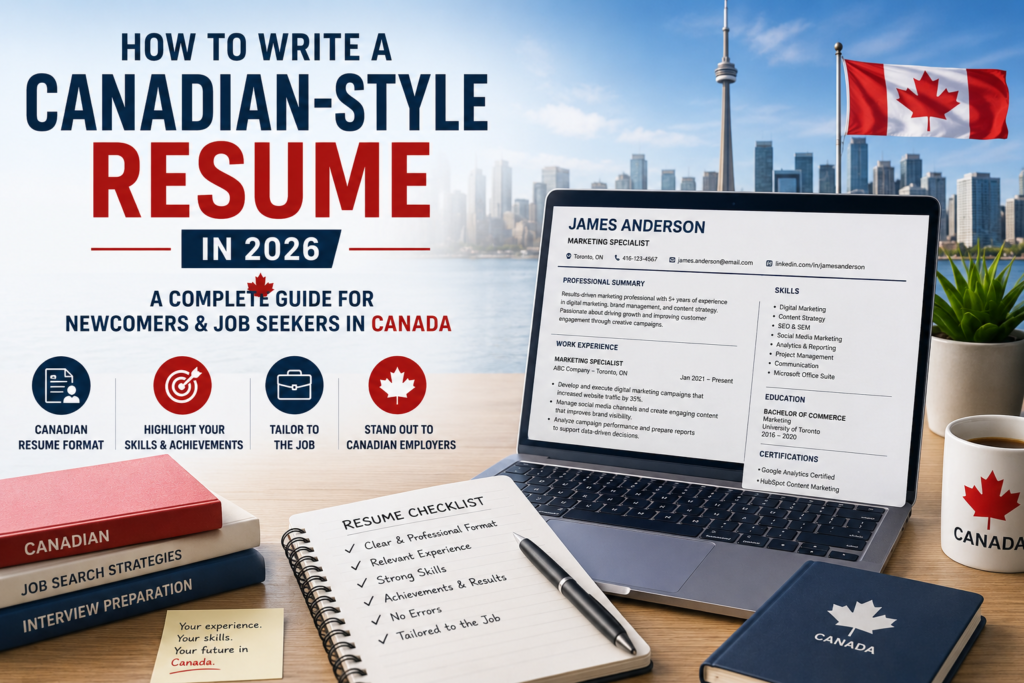
Essential Sections of a Canadian-Style Resume
Most Canadian resumes include the following sections:
- Contact information
- Professional summary
- Work experience
- Education
- Skills
- Certifications or licences, where applicable
- Volunteer experience, if relevant
Tailor each section to the specific job you are applying for.
Keep Your Contact Information Professional
Your contact section should generally include:
- Full name
- Telephone number
- Professional email address
- City and province or territory of residence
You do not normally need to include personal information such as:
- Age
- Date of birth
- Marital status
- Religion
- Nationality
- Photograph, unless specifically requested
Keeping your resume focused on your professional qualifications helps employers evaluate your suitability for the role.
Write a Strong Professional Summary
Your professional summary appears near the top of your resume and provides a brief overview of your qualifications.
An effective summary should highlight:
- Years of relevant experience
- Key skills
- Industry expertise
- Career goals related to the position
Keep this section concise and relevant to the job.
Highlight Your Work Experience
When describing your work experience:
- List your most recent position first.
- Include your job title, employer, and employment dates.
- Describe your responsibilities and achievements.
- Focus on accomplishments that demonstrate value.
Whenever appropriate, include measurable achievements that show the results of your work.
Showcase Your Skills
Employers often look for both technical and workplace skills.
Examples include:
- Communication
- Teamwork
- Problem-solving
- Customer service
- Leadership
- Computer proficiency
- Industry-specific technical skills
Include skills that are directly relevant to the position.
Tailor Your Resume for Every Job
Avoid sending the same resume to every employer.
Instead:
- Read the job description carefully.
- Highlight experience relevant to that position.
- Include keywords that match the employer’s requirements where appropriate.
- Remove information that is unrelated to the role.
A customized resume is often more effective than a generic one.
Common Resume Mistakes to Avoid
Many qualified applicants reduce their chances by making avoidable errors.
Common mistakes include:
- Spelling and grammar mistakes
- Including unnecessary personal information
- Using an unprofessional email address
- Submitting a generic resume for every application
- Listing outdated or irrelevant experience
- Making the resume excessively long
Review your resume carefully before submitting it.
Tips to Make Your Resume Stand Out
To strengthen your Canadian-style resume:
- Keep the layout clean and professional.
- Use consistent formatting throughout.
- Focus on achievements rather than only responsibilities.
- Tailor your resume to each job application.
- Proofread carefully before sending it.
- Update your resume regularly as your experience grows.
A polished resume can leave a positive impression on employers.
Why Professional Guidance Can Help
Understanding Canadian hiring practices can be challenging, especially for newcomers.
Professional career guidance can help you:
- Improve your resume.
- Prepare for interviews.
- Understand employer expectations.
- Build an effective job search strategy.
- Increase your confidence during the hiring process.
Taking advantage of available support can make your transition into the Canadian workforce smoother.
Final Thoughts
Creating a strong Canadian-style resume is one of the most important steps in your job search. A well-written resume helps employers quickly understand your qualifications and demonstrates that you are prepared for the Canadian workplace.
By tailoring your resume to each position, emphasizing relevant achievements, and avoiding common mistakes, you can improve your chances of securing interviews and advancing your career in Canada.
Need Help Preparing for Your New Life in Canada?
Worldbridge Immigration supports individuals and families throughout every stage of their Canadian journey. From immigration applications to settlement guidance, we help newcomers prepare for success in Canada.
Whether you are planning to work, study, or settle permanently, our experienced team is ready to guide you toward your goals.