Nigerians planning to study in Canada should expect a little more time for their applications.
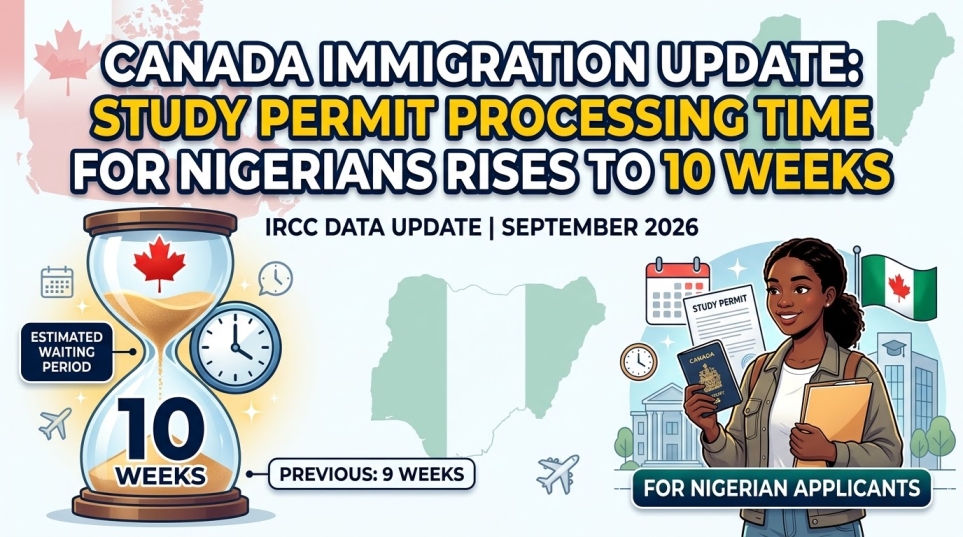
As of Immigration, Refugees and Citizenship Canada’s September 16, 2026 processing-time update, the estimated processing time for Canadian study permits submitted from Nigeria increased from 9 weeks to 10 weeks.
The change is important for students planning their admission, travel and school start dates because processing time is only one part of the timeline. Applicants also need to account for document preparation, biometrics, medical examinations where required and any additional processing requested by IRCC.
Canada study permit processing time for Nigerians
The latest figures show the following temporary-residence processing estimates for applicants from Nigeria:
| Application | September 16, 2026 estimate |
|---|---|
| Study permit | 10 weeks |
| Work permit | 10 weeks |
| Visitor visa | 87 days |
| Super visa | 46 days |
The study-permit estimate increased by one week compared with the previous September 9 update.
For comparison, the study-permit estimate for applicants applying from India was 5 weeks, while applicants applying from Pakistan faced an estimated 7-week wait.
These figures can change from one weekly update to another.
What does 10 weeks actually mean?
A 10-week processing time does not mean every Nigerian applicant will receive a decision exactly 10 weeks after submitting an application.
IRCC explains that processing times are estimates rather than guarantees or maximum waiting periods.
Some applications can take longer because of factors such as application complexity, additional document requests, security or background checks, the volume of applications in the inventory and the time required to verify information.
This is why students should avoid treating the published processing time as a fixed deadline.
If a student needs to be in Canada by a particular date, waiting until the last few weeks before the intended start date can create unnecessary pressure.
Students should plan earlier
For Nigerian students, the most important lesson from the latest update is simple: build enough time into your study-abroad plan.
Getting admission to a Canadian institution does not automatically mean you can travel to Canada immediately.
A student may need to complete several steps before and after receiving an admission offer.
These can include:
- Obtaining the required admission documents
- Meeting the requirements for a Provincial Attestation Letter where applicable
- Preparing proof of financial support
- Completing biometrics
- Completing a medical examination if required
- Preparing a study-plan or letter of explanation where appropriate
- Submitting the study-permit application
- Waiting for IRCC to process the application
- Completing travel preparations after approval
A delay at one stage can affect the entire timeline.
Do not confuse processing time with approval
Another important point is that faster or slower processing does not determine whether an application will be approved.
Processing time is about how long IRCC may take to make a decision. Eligibility and admissibility are separate issues.
A student can submit an application quickly and still receive a refusal if the application does not satisfy the requirements.
This is why rushing to submit simply because a school deadline is approaching can be risky.
The application should be complete, consistent and supported by credible documentation.
What about Nigerian students already in Canada?
The latest update also shows a separate figure for applicants applying from inside Canada.
For study permits, IRCC’s September 16 estimate for applications from within Canada was 8 weeks, compared with 7 weeks in the previous update.
This can matter to students who are already in Canada and need to extend or change their study status.
However, applicants should not assume that the processing estimate automatically gives them permission to remain in Canada or continue studying.
Their immigration status and the conditions attached to their current documents still matter.
Visitor visa processing is also significant
The latest update was not limited to study permits.
For Nigerian applicants, the estimated visitor-visa processing time was 87 days, compared with 84 days in the previous update.
That can matter to people planning to visit family members in Canada, attend events or travel for other temporary purposes.
Again, the published figure is an estimate rather than a guarantee.
What Nigerian applicants should do now
If you are planning to apply for a Canadian study permit, the best approach is to work backwards from your intended school start date.
Do not start with the assumption that IRCC will make a decision within exactly 10 weeks.
Instead, give yourself additional time for preparation and possible delays.
You should also monitor IRCC’s processing-time updates after submitting your application because temporary-residence estimates are updated regularly.
The latest update was published on September 16, and another update was expected around September 23.
This means the estimate could change again very soon.
The bigger picture for Nigerian students
The increase from 9 to 10 weeks is not a dramatic change on its own, but it is another reminder that studying in Canada requires careful timing.
Canada continues to manage the number of temporary residents entering the country while maintaining immigration programs designed around economic and labour-market needs.
For prospective students, this makes preparation increasingly important.
A strong application is not only about getting admission to a Canadian school. Applicants also need to understand the immigration requirements, prepare their documents properly and give themselves enough time for the federal application process.
Planning to study in Canada?
If you are a Nigerian student considering Canada, Worldbridge Immigration can help you assess your study-permit options, review your immigration pathway and prepare for the application process.
Important: Worldbridge Immigration is a private immigration consultancy and is not affiliated with or endorsed by the Government of Canada or Immigration, Refugees and Citizenship Canada (IRCC). Immigration rules and processing times can change, so applicants should always verify the latest official requirements before applying.