
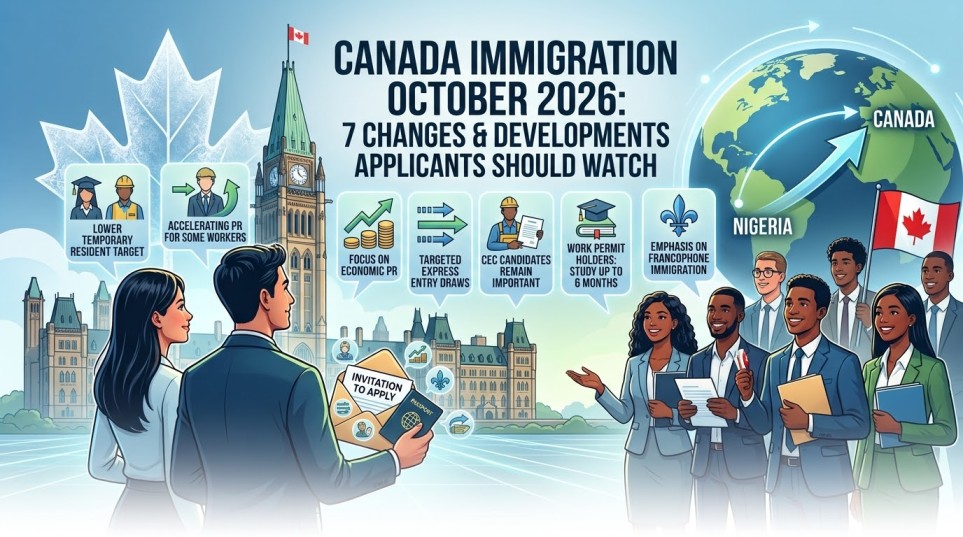
October begins with Canada’s immigration system in a very different position from where it was a few years ago.
The country is reducing new temporary resident arrivals, keeping permanent resident admissions relatively stable, targeting specific skills through Express Entry and creating measures aimed at helping some temporary workers transition to permanent residence.
For people planning to study, work or immigrate to Canada, October is therefore a good time to review what has changed and what could affect their plans over the final months of 2026.
Here are seven developments applicants should be watching.
1. Canada is maintaining a lower temporary resident target
Canada’s 2026 Immigration Levels Plan sets a target of 385,000 new temporary resident arrivals in 2026.
That includes 155,000 international students and 230,000 temporary workers.
The figures are considerably lower than the temporary resident targets used in previous years.
The government has said its objective is to reduce the temporary resident population to less than 5% of Canada’s total population by the end of 2027.
For international students and temporary foreign workers, this means Canada is continuing to manage temporary immigration more tightly.
This does not mean Canada has stopped accepting international students or workers.
It means applicants should expect greater attention to program requirements, available spaces, labour-market needs and the overall immigration targets.
2. Permanent residence remains focused on economic immigration
Canada’s permanent resident target for 2026 is 380,000 admissions.
The government is not simply reducing permanent immigration alongside temporary immigration.
Instead, the 2026–2028 plan places significant emphasis on economic immigration and on selecting people whose skills match Canada’s labour-market needs.
The plan also increases the proportion of economic immigrants in future years, reaching 64% of permanent resident admissions in 2027 and 2028.
For applicants, this reinforces an important point: having a pathway to Canada is not enough.
The Canadian immigration system is increasingly focused on what an applicant can contribute through skills, work experience, occupation and other economic factors.
3. Express Entry is becoming more targeted
Express Entry remains one of Canada’s main economic immigration systems, but applicants should no longer think of it simply as a competition for the highest CRS score.
IRCC’s 2026 categories include French-language proficiency, healthcare and social services, STEM, trades, education and transport.
There are also new categories for physicians with Canadian work experience, senior managers with Canadian work experience, researchers with Canadian work experience and certain foreign military applicants.
This means two candidates with very different profiles can have very different opportunities even if their CRS scores are similar.
For example, a candidate with a moderate CRS score who meets the requirements of a category-based draw may have an opportunity that another candidate with a similar score does not.
Applicants should therefore look beyond the general CRS number and determine which Express Entry programs and categories they may qualify for.
4. Canadian Experience Class candidates remain important
Recent Express Entry draws have shown the continuing importance of the Canadian Experience Class.
In September, IRCC held Canadian Experience Class rounds that invited 2,000 candidates at CRS scores of 521 on September 1 and 519 on September 15.
A further CEC draw on September 29 also invited 2,000 candidates, with a CRS cut-off of 518.
The Canadian Experience Class is specifically designed for people with qualifying Canadian skilled work experience.
That makes the program particularly relevant to some temporary workers and international graduates who have transitioned into eligible employment in Canada.
However, applicants outside Canada should not assume that a CEC CRS score is available to them simply because their CRS score is high enough.
The program has its own eligibility requirements, including qualifying Canadian work experience.
5. Eligible work permit holders can now study for up to six months without a study permit
One of the more important recent changes affects people who are already working in Canada.
Under a temporary measure introduced in September, eligible work permit holders can study for up to six months without obtaining a separate study permit.
The measure is available until December 31, 2027, although the worker can only study for up to six months or until their work permit expires, whichever comes first.
It is designed to give eligible workers more flexibility to take short-term education, training or licensing programs.
For example, a worker may be able to use the measure to obtain additional training or skills while continuing to work.
There is an important limitation.
Full-time studies still require a study permit.
The measure is also not a new immigration pathway for people outside Canada. It is aimed at eligible workers who are already in Canada.
6. Canada is putting more emphasis on Francophone immigration
French-speaking applicants should continue watching Canada’s immigration strategy closely.
The government has committed to increasing the proportion of French-speaking permanent residents admitted outside Quebec, with a target of 10.5% by 2028 and a broader goal of reaching 12% by 2029.
On September 29, the federal government also announced funding for new projects intended to promote Francophone immigration and strengthen Francophone minority communities.
One of the projects involves Newfoundland and Labrador and aims to attract Francophone and bilingual workers through targeted overseas recruitment.
The sectors mentioned include education, early childhood education and healthcare.
For French-speaking applicants, this does not mean that every Francophone applicant will automatically receive an immigration opportunity.
However, French-language ability is already one of the categories used in Express Entry, making it an important factor for eligible candidates.
7. Canada is accelerating some temporary workers toward permanent residence
Another development applicants should understand is the one-time In-Canada Workers Initiative.
The 2026–2028 Immigration Levels Plan includes a two-year initiative intended to accelerate the transition of up to 33,000 temporary workers to permanent residence during 2026 and 2027.
The initiative focuses on workers who are already contributing to Canada’s economy and communities, including people working in in-demand sectors and rural areas.
This is significant because it reflects a broader direction in Canada’s immigration policy.
Rather than relying entirely on bringing new temporary workers into the country, Canada is also looking at how people who are already working and established in Canada can transition to permanent residence.
However, this should not be interpreted as an open application program where every temporary worker can simply apply for the 33,000 spaces.
The initiative is targeted, and eligibility depends on the applicable immigration programs and measures.
What does all of this mean for people planning to move to Canada?
The main message going into October is that Canadian immigration is becoming more targeted.
For international students, the reduced temporary resident targets mean study permit applicants should pay close attention to current requirements, financial capacity and the rules governing their particular program.
For temporary workers, Canadian work experience may become increasingly important, particularly where it supports eligibility for economic permanent residence pathways.
For skilled workers outside Canada, occupation, language ability, education and provincial opportunities remain important.
And for French-speaking applicants, language ability can provide access to a specific Express Entry category while Canada’s broader Francophone immigration strategy continues to expand.
Should applicants wait for the next Express Entry draw?
Waiting for a particular CRS cut-off is not necessarily the best immigration strategy.
Express Entry draws can vary by program and category.
A candidate who focuses only on the latest CRS number may miss a more suitable pathway through a provincial nomination, a category-based Express Entry round or another economic immigration program.
Instead, applicants should first determine which programs they are eligible for.
Then they can identify the factors that could strengthen their profile.
This might include improving language results, obtaining an Educational Credential Assessment, gaining additional skilled work experience, exploring a provincial nomination or developing French-language ability.
What Nigerian applicants should review this October
For Nigerians considering Canada, October is a good time to conduct a full immigration profile review.
Check your age, education, work experience, occupation, language test results and marital status.
If you have studied or worked in Canada, check whether your Canadian experience can support an economic immigration pathway.
If you are outside Canada, examine both federal and provincial options rather than focusing exclusively on Express Entry.
International students should also calculate the current financial requirements for their intended study permit application and confirm that their chosen program and institution remain suitable under Canada’s current rules.
Most importantly, do not build an immigration plan around an old CRS score or an immigration rule from a previous year.
Canada’s system is changing quickly, and eligibility needs to be assessed using the rules that apply when the application is actually submitted.
Final thoughts
October 2026 begins with several important developments already shaping Canada’s immigration system.
Temporary resident arrivals are being kept at lower levels, while permanent residence remains focused heavily on economic immigration.
Express Entry is targeting specific skills and experience, including healthcare, trades, French-language ability, transport and other priority categories.
At the same time, Canada is creating measures to help some temporary workers build skills and transition toward permanent residence.
For prospective immigrants, the lesson is straightforward: the Canadian immigration system is becoming more targeted, not necessarily closed.
The strongest approach is to understand where your profile fits within the current system before choosing a pathway.
Worldbridge Immigration can help prospective immigrants assess Express Entry, Provincial Nominee Programs, study pathways and other Canadian immigration options based on their individual circumstances.