Canada has introduced targeted immigration measures to make it easier for internationally trained doctors to work in the country and eventually become permanent residents.
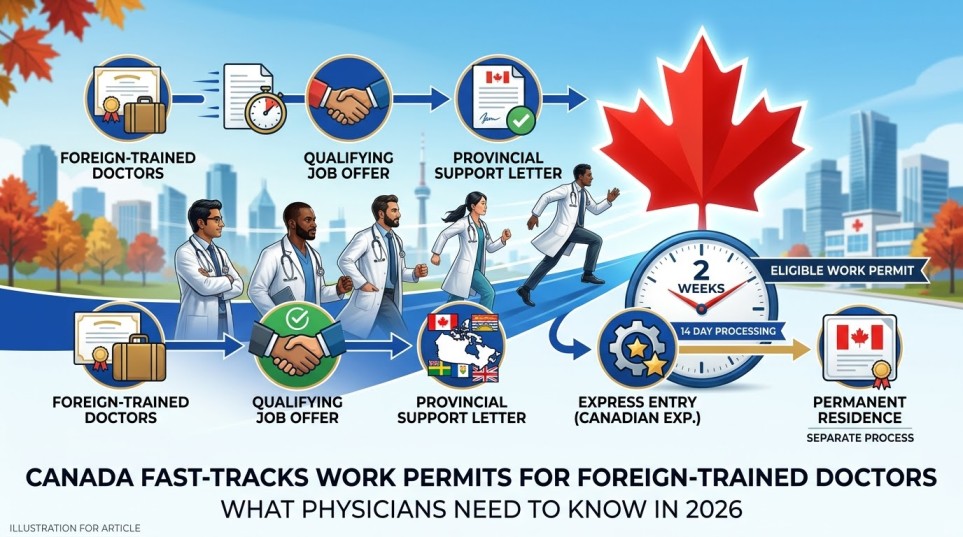
One of the most notable measures allows eligible physicians to receive 14-day processing for their work permit applications when they meet the required conditions.
But there is an important distinction that prospective applicants need to understand.
Canada is not offering permanent residence to foreign-trained doctors in 14 days.
The 14-day timeline applies to the processing of an eligible work permit. Permanent residence remains a separate immigration process.
For doctors considering Canada, the new measures could nevertheless create a clearer route into the Canadian healthcare system, particularly for physicians who can secure provincial support and a qualifying job offer.
What has Canada changed for foreign-trained doctors?
The federal government announced a package of measures designed to make the immigration pathway for international doctors simpler.
The measures include:
- A new Express Entry category for physicians with Canadian work experience
- Up to 5,000 federal admission spaces reserved for provinces and territories to nominate licensed doctors with job offers
- Expedited 14-day processing for eligible physician work permit applications
The government says the measures are intended to help address critical healthcare labour shortages while making better use of doctors who are already working in Canada.
This is part of Canada’s broader effort to attract healthcare professionals and address gaps in its health workforce.
What does the 14-day processing actually mean?
This is where applicants need to be careful.
The 14-day period applies to work permit processing, not permanent residence.
An eligible doctor can potentially have their work permit application processed within 14 days if they meet the requirements and submit a complete application.
The purpose is to allow the physician to begin working in Canada while their longer-term permanent residence process continues separately.
In other words:
14-day work permit processing ≠ 14-day permanent residence
A doctor should therefore be suspicious of advertisements or social media posts claiming that Canada is offering “14-day PR” to foreign physicians.
That is not what the Canadian government announced.
Which doctors can qualify for the faster work permit processing?
The federal government identifies three eligible physician occupations under the National Occupational Classification system.
They are:
| NOC | Occupation |
|---|---|
| 31100 | Specialists in clinical laboratory medicine |
| 31101 | Specialists in surgery |
| 31102 | General practitioners and family physicians |
The physician must have a full-time, non-seasonal job offer in one of these occupations.
They must also have a support letter from the Canadian province or territory that has nominated them for permanent residence through the Provincial Nominee Program.
The doctor does not necessarily have to have submitted the permanent residence application before applying for the work permit.
IRCC also requires applicants to meet the general conditions for obtaining a work permit.
What does a doctor need before applying?
The faster processing is not automatic.
A physician needs to put the appropriate documentation together before submitting the work permit application.
This includes the provincial or territorial support letter and the required employer documents.
IRCC specifically warns applicants to confirm that they are using the correct NOC.
This matters because selecting the wrong occupation can make the applicant ineligible for the special processing.
The work permit application must also be complete.
Missing documents can cause delays even when an applicant otherwise appears to qualify.
The provincial nomination is extremely important
The 14-day work permit measure is closely connected to Canada’s Provincial Nominee Program.
A physician cannot simply apply for the faster processing because they are a doctor.
The province or territory needs to support the physician’s application under the relevant nomination process.
This means doctors interested in the pathway should not focus only on the federal immigration requirements.
They also need to identify provinces that are recruiting physicians and understand the provincial nomination and medical licensing requirements that apply there.
The province is effectively playing an important role in connecting the physician’s immigration application to an actual healthcare workforce need.
Canada has also reserved 5,000 federal admission spaces for doctors
The federal government has announced that 5,000 federal admission spaces will be reserved for provinces and territories to nominate licensed doctors with job offers.
These spaces are in addition to the provinces’ regular annual Provincial Nominee Program allocations.
This is significant because it creates an additional immigration opportunity specifically connected to Canada’s need for physicians.
However, the 5,000 spaces should not be interpreted as 5,000 guaranteed places for any foreign-trained doctor who applies.
A physician still needs to meet the applicable requirements and secure the necessary provincial nomination or support.
The provinces and territories determine how their physician recruitment and nomination processes operate.
There is also a new Express Entry category for physicians
Canada has introduced a dedicated Express Entry category for physicians with Canadian work experience.
Under the federal measure, eligible international doctors need at least one year of Canadian work experience in an eligible physician occupation within the previous three years.
The category is intended to give doctors who are already working in Canada a clearer route toward permanent residence.
This is different from the provincial route for doctors who are outside Canada.
The distinction is important because Canadian work experience is specifically relevant to this Express Entry category.
Why Canada’s physician strategy is different from a normal Express Entry application
A doctor applying through ordinary economic immigration pathways has to compete within the relevant Express Entry selection system.
The physician measures create more targeted opportunities.
For example, IRCC has been conducting dedicated Express Entry draws for physicians with Canadian work experience.
This means an eligible doctor may be selected through a category-based draw even when their CRS score would not be competitive in a general Express Entry round.
Canada’s 2026 Express Entry priorities already include physicians with Canadian work experience alongside other targeted categories.
The federal government is therefore using immigration selection to address specific labour shortages rather than relying entirely on general CRS rankings.
What about doctors currently outside Canada?
Foreign-trained doctors living outside Canada may still have opportunities, but they should understand that immigration is only one part of the process.
A doctor may need to obtain provincial support, secure an appropriate job offer and satisfy Canadian medical licensing or registration requirements before they can practise medicine.
This is particularly important because medicine is a regulated profession in Canada.
Being a qualified doctor in another country does not automatically give someone a licence to practise independently in Canada.
The immigration process and professional licensing process therefore need to be planned together.
Medical licensing may be the bigger challenge
For an internationally trained physician, obtaining immigration approval does not automatically mean they can start practising medicine.
The physician needs to satisfy the requirements of the relevant Canadian medical regulator.
The exact process depends on the doctor’s specialty, education, training, province and intended practice.
Canada has been working to reduce barriers for internationally educated healthcare professionals, including investment in foreign credential recognition and other initiatives.
However, physicians should expect licensing and credential recognition to require significant preparation.
The immigration pathway should therefore not be treated as the only part of the process.
What does this mean for Nigerian doctors?
The new measures are particularly worth watching for Nigerian physicians considering Canada.
A Nigerian doctor may potentially benefit from the physician-focused immigration measures if they meet the relevant federal and provincial requirements.
But being Nigerian does not create a special immigration advantage or disadvantage under the 14-day work permit measure.
The pathway is based on eligibility, occupation, provincial support, job offer and other requirements.
Nigerian doctors should therefore avoid relying on social media posts that describe the measure as a special programme for a particular nationality.
The important question is whether the individual physician meets the Canadian requirements.
Doctors should prepare before contacting a province
Physicians interested in Canada should begin organizing their documents early.
Depending on the pathway, this can include:
- Medical education records
- Proof of postgraduate training
- Professional registration and licensing documents
- Employment records
- Language test results where required
- Identity documents
- References and evidence of clinical experience
- Specialty documentation
- Credential assessment or verification documents where applicable
Having these documents ready can make it easier to respond when a suitable provincial opportunity becomes available.
The 14-day timeline does not eliminate immigration processing
Another misconception is that a doctor who receives the fast work permit automatically receives permanent residence soon afterward.
That is not how the system works.
The work permit allows the physician to work temporarily in Canada.
Permanent residence remains a separate process.
Depending on the pathway, the physician may need to proceed through Express Entry or a Provincial Nominee Program and then submit the required permanent residence application.
The government has created a faster work permit process because it wants eligible doctors to begin contributing to Canada’s healthcare system sooner.
It has not eliminated the permanent residence requirements.
What should doctors do now?
Physicians considering Canada should approach the process in stages.
First, identify your occupation
Confirm whether your role corresponds to one of the eligible physician NOCs.
Do not assume that being a medical professional automatically qualifies you for the physician-specific measures.
Second, investigate provincial opportunities
Look for provinces that are recruiting physicians in your specialty and determine whether you meet their nomination requirements.
A genuine job opportunity and provincial support are central to the faster work permit route.
Third, begin the licensing process
Do not wait until after receiving immigration approval to start thinking about professional licensing.
The requirements can take time, and licensing is separate from immigration.
Fourth, assess your permanent residence pathway
Determine whether you could qualify through the physician Express Entry category, a Provincial Nominee Program or another economic immigration pathway.
Finally, verify the rules
Immigration and professional licensing requirements can change.
Always confirm the current requirements before submitting applications or paying anyone to handle the process.
A significant opportunity, but not a shortcut
Canada’s physician measures represent a genuine opportunity for some internationally trained doctors.
The federal government has created a dedicated Express Entry category for physicians with Canadian work experience, reserved 5,000 federal admission spaces for provinces and territories to nominate licensed doctors with job offers, and introduced faster work permit processing for eligible physicians.
But the measures do not eliminate the requirements that doctors must satisfy.
There is no 14-day permanent residence programme.
There is no automatic PR simply because someone is a doctor.
And immigration approval does not automatically provide a licence to practise medicine.
For physicians who understand these distinctions and prepare their immigration and licensing processes together, however, Canada’s current approach could provide a more structured route into the country’s healthcare workforce.
Final thoughts
Canada is actively looking for ways to bring more physicians into its healthcare system, and the immigration measures introduced for internationally trained doctors are part of that effort.
The most attractive feature for eligible physicians may be the 14-day work permit processing, but that benefit should not be confused with permanent residence.
The real opportunity is the combination of provincial recruitment, faster work authorization and targeted permanent residence pathways.
For Nigerian and other internationally trained doctors considering Canada, the right starting point is therefore not a promise of “14-day PR.”
It is a proper assessment of your medical credentials, specialty, licensing prospects, provincial opportunities and immigration eligibility.
Worldbridge Immigration can help prospective immigrants assess Canadian immigration pathways and understand how provincial nomination, Express Entry and other requirements fit into their plans.