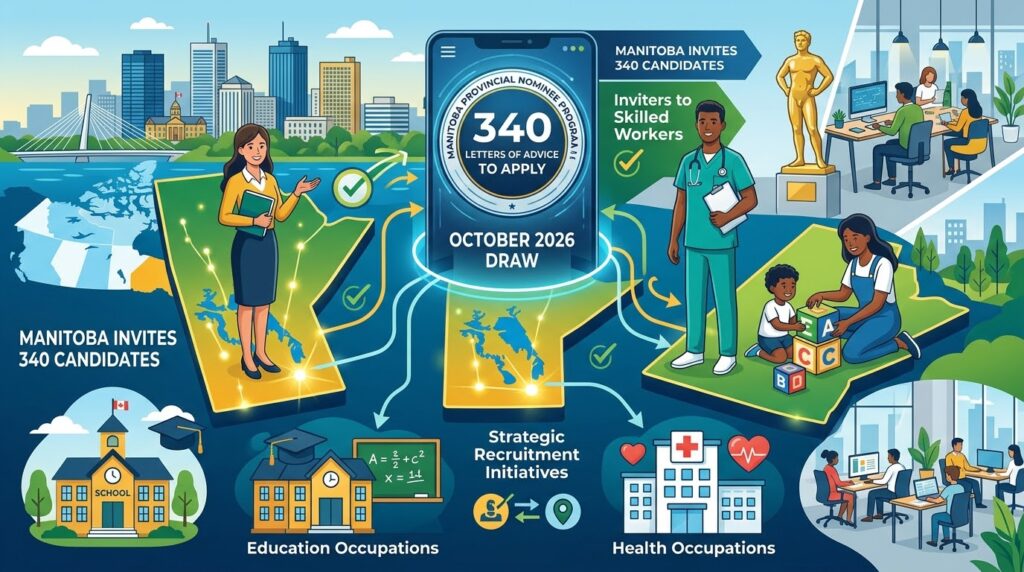
Manitoba has issued 340 Letters of Advice to Apply in its latest Provincial Nominee Program draw, giving selected workers another opportunity to pursue permanent residence in Canada.
The Manitoba Provincial Nominee Program (MPNP) held the selection round on October 8, 2026. Education and healthcare workers featured prominently, while the province also invited candidates through strategic recruitment initiatives.
For Nigerians considering Canada, the draw offers an important lesson: immigration opportunities do not exist only through federal Express Entry. Provincial programmes can also provide routes to permanent residence for candidates whose experience matches local labour needs.
However, this draw was targeted. It does not mean that every teacher, healthcare worker or overseas applicant can apply successfully.
What happened in Manitoba’s October 8 draw?
Manitoba issued 340 Letters of Advice to Apply across two broad selection groups.
| Selection group | Invitations issued |
|---|---|
| Teachers and education-related occupations under Skilled Worker in Manitoba | 211 |
| Health workers under Skilled Worker in Manitoba | 46 |
| Candidates selected through strategic recruitment initiatives | 83 |
| Total | 340 |
The first two groups accounted for 257 invitations through the Skilled Worker in Manitoba pathway.
The remaining 83 invitations went to candidates considered under strategic recruitment initiatives through the Skilled Worker Stream. These selections included candidates directly invited by the MPNP through strategic recruitment or the applicable temporary public policy for prospective nominees.
The distinction matters because candidates were not selected through a single general draw open to everyone. Manitoba targeted particular occupations and recruitment priorities.
Which education workers were selected?
Education-related occupations received the largest share of invitations.
Manitoba issued 211 Letters of Advice to Apply to candidates who declared current employment in one of the following National Occupational Classification (NOC) 2021 groups:
- NOC 41220: Secondary school teachers
- NOC 41221: Elementary school and kindergarten teachers
- NOC 42202: Early childhood educators and assistants
- NOC 43100: Elementary and secondary school teacher assistants
These occupations cover different roles, from classroom teaching to early childhood education and teaching support.
The selection shows that Manitoba is using provincial immigration to respond to specific workforce priorities.
However, the invitation numbers do not establish that every worker in these occupations is eligible. Candidates must still meet the relevant programme requirements, and selection depends on the province’s criteria and priorities.
Does this mean Nigerian teachers can apply from Nigeria?
Not automatically.
The 211 education-related invitations were issued through the Skilled Worker in Manitoba pathway, and the selected candidates declared current employment in Manitoba in the specified occupations.
This is a critical detail for overseas applicants.
A Nigerian teacher working in Nigeria should not interpret the draw as an invitation to submit an application under the same pathway without first establishing eligibility.
Candidates outside Canada need to investigate immigration pathways that accept overseas applicants and verify whether their occupation, employment history, qualifications and other circumstances meet the requirements.
Teaching qualifications may also need to be assessed separately for employment and professional certification in Canada. Meeting immigration requirements does not automatically authorize someone to practise a regulated profession.
What about healthcare workers?
Healthcare workers received another 46 invitations under the Skilled Worker in Manitoba pathway.
These selections were based on candidates reporting current employment in health occupations.
The result reinforces the importance of healthcare in Manitoba’s provincial immigration priorities. However, it does not establish a new immigration pathway specifically for Nigerian doctors, nurses or other healthcare professionals.
Healthcare workers should distinguish between three separate issues:
- Whether they qualify for an immigration programme.
- Whether their occupation and experience meet the programme’s selection requirements.
- Whether they need Canadian licensing, registration or additional training to practise their profession.
For example, a nurse may have relevant qualifications and work experience but still need to meet provincial registration requirements before practising in Manitoba.
Similarly, a doctor should investigate the applicable medical licensing and immigration requirements rather than assuming that professional experience alone guarantees eligibility.
The latest draw is useful evidence of Manitoba’s selection priorities, but it is not a guarantee of future invitations.
What are strategic recruitment initiatives?
The remaining 83 invitations were issued through the Skilled Worker Stream to candidates directly invited under strategic recruitment initiatives or the applicable temporary public policy for prospective nominees.
Strategic recruitment allows Manitoba to identify candidates through specific recruitment activities and provincial priorities.
Depending on the initiative, candidates may need to demonstrate a connection to Manitoba or have been directly approached through an eligible recruitment process.
This means that simply creating an expression of interest does not guarantee selection through these initiatives.
Candidates should check the official MPNP requirements to understand whether they can participate in a relevant recruitment initiative and whether they need a direct invitation.
How does the Manitoba Provincial Nominee Program work?
The MPNP allows Manitoba to nominate eligible candidates who can contribute to the province’s economy and labour market.
A provincial nomination is not the same as permanent residence approval. Candidates must follow the relevant application process and satisfy the applicable federal requirements.
Manitoba has different pathways and selection mechanisms, including options for eligible skilled workers in the province and candidates selected through specific recruitment initiatives.
Eligibility can depend on factors such as:
- Employment and work experience
- Education and professional qualifications
- Language ability
- Connections to Manitoba
- The requirements of the particular MPNP pathway
- Current provincial selection priorities
Requirements vary between pathways, so applicants should not assume that meeting one criterion automatically qualifies them for nomination.
Some pathways are designed for people already working in Manitoba, while others may provide opportunities to eligible candidates overseas.
The correct approach is to identify the specific pathway first and then assess eligibility against its current rules.
What should Nigerian applicants do now?
The latest draw provides useful information, but applicants should turn that information into a realistic plan rather than rushing into an application.
1. Identify your actual occupation
Determine which occupation best reflects your work duties, not simply the title printed on your certificate or employment letter.
Canada uses the National Occupational Classification system to describe occupations. A suitable NOC classification depends on the actual duties and responsibilities of the job.
2. Check whether the pathway accepts overseas applicants
Do not assume that a draw targeting people already employed in Manitoba is available to candidates living in Nigeria.
Check the eligibility criteria for the specific pathway before spending money on an application.
3. Prepare your employment records
Keep accurate employment reference letters, job descriptions, dates of employment and other supporting records.
The information should be consistent and should accurately reflect your experience.
4. Review your education and language requirements
Depending on the pathway, applicants may need evidence of their education, language ability and other qualifications.
For regulated professions, immigration eligibility and professional licensing should be assessed separately.
5. Monitor Manitoba’s official announcements
Provincial priorities and selection criteria can change. A successful draw does not guarantee that the same occupation will receive invitations in the next round.
Applicants should use the latest official programme information rather than relying solely on social media summaries.
Is Manitoba a better option than Express Entry?
There is no single answer for every applicant.
Express Entry manages applications for several federal economic immigration programmes and also supports category-based selection.
The MPNP is a provincial programme with its own eligibility requirements and selection priorities.
For some candidates, a provincial pathway may be worth exploring alongside federal options. For others, the requirements of a particular provincial stream may make it unsuitable.
Applicants should compare the available routes based on their qualifications, work experience, language results, employment circumstances and long-term plans.
They should also remember that a provincial nomination does not remove the need to satisfy applicable federal immigration requirements.
What does this draw tell us about Manitoba’s priorities?
The October 8 selection round shows Manitoba directing invitations towards specific workforce needs rather than distributing all invitations through a broad, undifferentiated selection.
Education and healthcare accounted for 257 of the 340 invitations, while another 83 went to candidates selected through strategic recruitment initiatives.
For prospective immigrants, the key lesson is that the occupation alone is not enough. Where a candidate works, which pathway they qualify for and whether they meet the selection criteria can be equally important.
The draw may be relevant to education and healthcare professionals considering Canada, but candidates should not assume that the same invitation numbers or selection criteria will continue in future rounds.
Final thoughts
Manitoba’s October 8 draw issued 340 Letters of Advice to Apply, with education and healthcare workers making up most of the selections through the Skilled Worker in Manitoba pathway.
For Nigerian applicants, the announcement is a useful reminder to look beyond Express Entry and investigate provincial immigration options where appropriate.
But a successful strategy begins with eligibility, not headlines.
Before applying, identify the correct pathway, verify the current requirements and establish whether your circumstances fit the province’s selection priorities.
Worldbridge Immigration can help prospective applicants assess their eligibility for Express Entry, Provincial Nominee Programs and other Canadian immigration pathways based on their individual circumstances.
Disclaimer: Worldbridge Immigration is a private immigration consultancy and is not affiliated with or endorsed by the Government of Canada or Immigration, Refugees and Citizenship Canada (IRCC). Immigration policies and eligibility requirements can change. Applicants should verify current official requirements before making an application or immigration decision.