
International students coming to Canada often have the same practical question after receiving their study permit: Can I work while studying in Canada?
The answer is yes, but only if you meet Canada’s eligibility requirements.
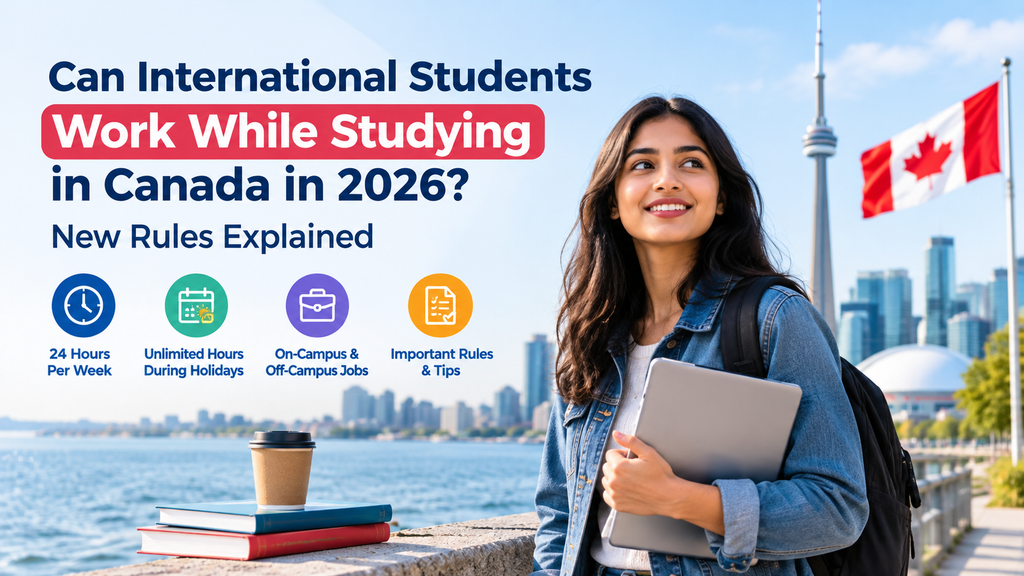
International students who are eligible to work off campus can generally work up to 24 hours per week during regular academic sessions and can work unlimited hours during scheduled breaks, such as winter or summer holidays, when they meet the applicable conditions.
However, not every international student is automatically allowed to work.
Understanding the rules before starting a job is important because working without the required authorisation can create immigration problems.
Can International Students Work in Canada?
Yes.
Eligible international students can work while studying without applying for a separate work permit in many circumstances.
However, several conditions must be satisfied.
For example, you generally need to:
- Hold a valid study permit
- Be studying at a designated learning institution
- Be enrolled in a qualifying full-time program
- Have started your studies
- Meet the requirements stated by the Canadian government for off-campus work
Your study permit should also indicate that you are authorised to work off campus.
If your study permit does not contain the appropriate condition, you may need to take additional steps before working.
How Many Hours Can Students Work?
During regular academic sessions, eligible international students can generally work up to 24 hours per week off campus.
This rule is important because some students still rely on older information suggesting that international students can work 20 hours per week.
Canada increased the limit from 20 to 24 hours per week in November 2024.
Working more than the permitted number of hours during a regular academic period can put a student’s immigration status at risk.
The 24-hour limit applies to off-campus work during regular academic sessions.
Can Students Work Full-Time During Holidays?
Eligible students can generally work unlimited hours during scheduled breaks.
Examples can include a scheduled summer break or winter break, provided the break meets the requirements under the study permit rules.
This does not mean that students can simply decide that they are taking a break from school and then work unlimited hours.
The break needs to be a scheduled break in the academic calendar and the student must continue to meet the applicable eligibility conditions.
Students should therefore check their school’s academic calendar before assuming that a particular period qualifies as a scheduled break.
What Counts as Off-Campus Work?
Off-campus work generally refers to employment outside the institution where you study.
This could include jobs such as:
- Retail work
- Restaurant jobs
- Administrative work
- Customer service
- Warehouse work
- Hospitality
- Certain professional or skilled employment
The type of job is not necessarily limited to work related to your field of study.
However, the student must still comply with the conditions attached to their study permit and Canadian immigration rules.
What About On-Campus Jobs?
On-campus employment is treated differently.
Eligible international students can generally work on campus without the same 24-hour weekly limit that applies to off-campus work.
An on-campus job could include working for:
- Your university
- Your college
- A faculty
- A campus library
- A campus research department
- A business located on campus
The exact definition of on-campus employment matters, especially when a business operates on campus but is not directly connected to the educational institution.
Students should confirm that the job qualifies as on-campus employment before relying on the rules for on-campus work.
Can You Work Two Jobs?
Yes, an eligible student can generally have more than one job.
The important issue is the total number of hours worked during regular academic sessions.
For example, imagine a student works:
Job 1: 14 hours per week
Job 2: 10 hours per week
The total is 24 hours per week.
That remains within the general off-campus limit.
But if the student works 18 hours at one job and another 10 hours at a second job, the total becomes 28 hours.
Having two employers does not create two separate 24-hour limits.
The limit applies to the student’s total off-campus working hours.
Can Students Be Self-Employed?
Self-employment can create additional complications.
Students who are self-employed must still follow the applicable work-hour restrictions.
For example, working for yourself, freelancing or providing services to clients does not necessarily mean that the hours are exempt from Canada’s student work rules.
A student should therefore keep proper records of working hours and income rather than assuming that freelance work falls outside the definition of work.
This is particularly important for students earning money through online businesses, freelance writing, graphic design, social media management, tutoring or other independent services.
What Happens If You Work More Than 24 Hours?
This is something students should take seriously.
The 24-hour limit is not simply a recommendation.
Working more than the permitted number of hours during a regular academic session can violate the conditions of your study permit.
Depending on the circumstances, this can affect your immigration status and future applications.
A student who is struggling financially may be tempted to accept additional shifts.
However, earning additional income today is not worth creating an immigration problem that could affect your future in Canada.
If you need more income, consider options that remain within the immigration rules rather than quietly exceeding the permitted hours.
Does Working Affect Your Studies?
There is another issue students sometimes overlook.
Even when you are legally allowed to work 24 hours per week, you still need to remain compliant with the conditions of your study permit.
Your primary purpose in Canada as an international student is to study.
If employment begins interfering with your studies, attendance or academic progress, you could create additional problems.
Working 24 hours every week may sound manageable, but the reality can be different when combined with lectures, assignments, examinations, commuting and personal responsibilities.
Students should therefore consider their academic workload before accepting additional shifts.
Can You Work Before Your Program Starts?
Generally, you cannot simply arrive in Canada with a study permit and immediately start working before you begin your studies.
The eligibility requirements for off-campus work include being actively studying in a qualifying program.
This means students should carefully check their circumstances before accepting employment during the period between arrival in Canada and the beginning of their academic program.
Having a valid study permit does not automatically mean you can start working immediately.
Can Part-Time Students Work?
This depends on the circumstances.
International students who are studying part-time may not automatically qualify for the same off-campus work authorisation available to full-time students.
There are specific exceptions, including certain students who are completing the final semester of their program and no longer need a full course load to graduate.
Students should therefore not assume that changing from full-time to part-time studies has no effect on their ability to work.
If your course load changes, check how the change affects your study permit and work eligibility.
Can Students Work During Their Final Semester?
A student who is in the final semester and has a reduced course load because they need fewer courses to complete their program may still be eligible to work, provided they meet the applicable requirements.
This is one situation where students should be particularly careful.
Do not assume that being registered for fewer courses automatically means you have lost your work authorisation.
The circumstances surrounding the reduced course load matter.
Keep documentation from your school showing why you are studying part-time during the final semester.
What About Co-op and Internship Work?
Co-op placements and internships can be subject to separate rules.
Students whose programs require work placements may need a co-op work permit, depending on the program and the nature of the placement.
This is different from simply working part-time at a restaurant, store or other employer while studying.
If a work placement is a mandatory part of your academic program, check the requirements before beginning the placement.
Can Students Work After Graduation?
The rules change once you complete your studies.
Eligible graduates may be able to apply for a Post-Graduation Work Permit (PGWP), which can allow them to gain Canadian work experience after completing their program.
However, not every graduate automatically qualifies for a PGWP.
Eligibility depends on factors including the institution, program, study requirements and other applicable conditions.
This is particularly important because Canada has changed its PGWP rules in recent years.
Students should therefore check the requirements that apply to their program rather than assuming that every Canadian graduate receives a work permit.
Can Income From a Student Job Help With Permanent Residence?
Canadian work experience can potentially become important for students who later want to apply for permanent residence.
For example, qualifying Canadian work experience may help an applicant become eligible for certain immigration programs or improve their profile depending on the program and circumstances.
But students should not choose a job solely because they believe it will automatically lead to permanent residence.
Not every job counts as qualifying skilled work for every immigration program.
The occupation, duties, hours and other requirements matter.
A part-time student job may therefore provide useful income and experience without necessarily becoming qualifying work experience for a particular permanent residence pathway.
Should You Rely on a Student Job to Fund Your Entire Education?
This is a risky strategy.
Students should generally plan their finances on the assumption that their primary funding is already available.
A part-time job can help with day-to-day expenses, but it should not be treated as a guaranteed solution for tuition and major living costs.
Canada requires international students to demonstrate that they have sufficient financial resources to support themselves.
As of September 1, 2026, a single student applying outside Quebec must demonstrate CAD $23,448 for annual living expenses, excluding tuition and transportation.
That requirement exists because students are expected to have adequate financial support rather than depend entirely on employment after arrival.
What About International Students in Quebec?
Quebec has its own immigration and education requirements.
Students planning to study in Quebec should therefore check the rules that apply to their situation rather than relying exclusively on federal information for students studying in other provinces.
The financial requirements can also differ.
Always confirm the rules applicable to your province and study program before making decisions about work or finances.
What Should Students Do Before Accepting a Job?
Before accepting employment, check a few basic things.
Check your study permit
Look for the conditions related to working in Canada.
Confirm your school status
Make sure you remain eligible to work based on your enrolment and program.
Track your hours
Keep a personal record of your working hours, particularly if you have more than one employer.
Check your academic calendar
Know when your scheduled breaks begin and end.
Keep your employment records
Save payslips, schedules and other employment documents.
These records can become useful if you ever need to demonstrate your employment history.
Common Mistakes International Students Should Avoid
Mistake 1: Assuming 20 hours is still the limit
Canada increased the off-campus limit to 24 hours per week.
Mistake 2: Thinking 24 hours applies to each employer
It does not.
The total off-campus hours matter.
Mistake 3: Working unlimited hours whenever school is not busy
Only qualifying scheduled breaks allow eligible students to work unlimited hours.
Mistake 4: Assuming online work does not count
Where work is performed while physically in Canada, students should not assume that being paid by an overseas client automatically removes immigration restrictions.
Mistake 5: Ignoring a change in student status
Changing programs, institutions or course loads can affect immigration conditions.
Mistake 6: Treating student employment as guaranteed PR
Working in Canada does not automatically result in permanent residence.
The Bottom Line
International students can work in Canada, but the right to work comes with conditions.
For eligible students, the general off-campus limit during regular academic sessions is 24 hours per week, while unlimited work may be permitted during qualifying scheduled breaks.
Students should also remember that employment is secondary to their studies.
The safest approach is to understand your study permit conditions, track your working hours and check the rules whenever your academic or immigration circumstances change.
Canada remains an attractive destination for international students, but the country’s student immigration system has become more regulated.
If you are planning to study in Canada in 2026, understanding the work rules before you arrive can help you avoid mistakes that could affect both your studies and your future immigration plans.
Planning to Study in Canada?
Worldbridge Immigration helps international students understand Canadian study permit requirements, financial documentation and immigration pathways.
If you are planning to study in Canada and want to understand how studying, working and potential post-graduation immigration options fit together, getting the right information before travelling can help you make better decisions.