
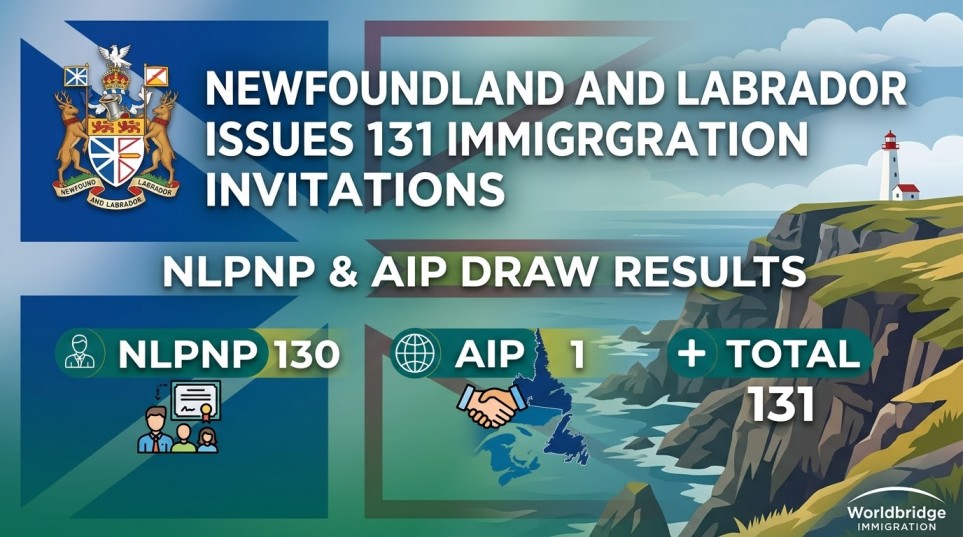
Newfoundland and Labrador has issued 131 immigration invitations in its latest selection round, creating another opportunity for eligible candidates seeking permanent residence in Canada.
The October 9, 2026, selection round included 130 invitations through the Newfoundland and Labrador Provincial Nominee Program (NLPNP) and one through the Atlantic Immigration Program (AIP).
For Nigerians planning to immigrate to Canada, the announcement highlights an important point: provincial immigration pathways can offer opportunities beyond federal Express Entry. However, candidates must understand the eligibility rules before deciding whether either programme suits their circumstances.
What happened in the October 9 immigration draw?
The province’s latest reported selection round produced the following results:
| Immigration programme | Invitations issued |
|---|---|
| Newfoundland and Labrador Provincial Nominee Program | 130 |
| Atlantic Immigration Program | 1 |
| Total | 131 |
The round followed a smaller selection on September 25, when the province issued 41 invitations through the NLPNP.
One important detail is that an invitation to apply is not the same as permanent residence approval. Candidates must still submit a complete application and meet the relevant programme requirements.
The reported October 9 results also do not provide an occupation-by-occupation breakdown or a CRS cutoff. Applicants should therefore avoid assuming that a particular occupation or Express Entry score was targeted.
What is the Newfoundland and Labrador Provincial Nominee Program?
The NLPNP allows the province to nominate eligible foreign nationals who can contribute to its workforce and economy.
Depending on the stream, eligibility can involve factors such as employment, education, work experience, language ability and an intention to settle in Newfoundland and Labrador.
A provincial nomination can support a permanent residence application, but it does not automatically guarantee approval by the federal government.
The programme’s requirements vary by pathway. Candidates should identify the stream that matches their circumstances instead of assuming that all applicants are assessed under the same criteria.
Can Nigerians apply from outside Canada?
Potentially, yes, but eligibility depends on the specific pathway and the candidate’s circumstances.
Living in Nigeria does not automatically make someone eligible for a provincial nomination. Applicants must meet the relevant criteria and follow the province’s application process.
Candidates should pay particular attention to employment requirements. Under Newfoundland and Labrador’s current Expression of Interest model, applicants seeking consideration through the NLPNP or AIP need a job or job offer from an employer in the province identified in their Expression of Interest.
That requirement makes the province’s employer and labour market connections especially important.
A Nigerian applicant should not assume that submitting an Expression of Interest without the required employment details will lead to an invitation.
How does the Atlantic Immigration Program work?
The Atlantic Immigration Program is an employer-driven pathway designed to help employers in Canada’s Atlantic provinces recruit eligible international workers and graduates.
The participating provinces are:
- Newfoundland and Labrador
- Nova Scotia
- New Brunswick
- Prince Edward Island
Unlike a general job search, the AIP requires candidates to follow a process involving an eligible designated employer and a qualifying job offer. The employer must meet the programme’s requirements, and the candidate must satisfy the applicable criteria.
Depending on the candidate’s situation, requirements may include relevant work experience or qualifying graduate status, education, language proficiency and settlement funds.
The programme is not an automatic route to permanent residence simply because someone finds a job in Atlantic Canada.
For Nigerian applicants, the practical first step is to identify employers and opportunities that genuinely fit the programme’s requirements. Applicants should verify an employer’s status and the job offer before paying recruitment-related fees or making commitments.
What is the Expression of Interest system?
Newfoundland and Labrador introduced an Expression of Interest (EOI) model for its economic immigration programmes in February 2025.
The system uses two main stages.
Stage 1: Submit an Expression of Interest.
The candidate provides information about their background, including education, occupation and intention to settle in the province. A qualifying job or job offer must be identified, and additional requirements, including employer invitation codes where applicable, must be followed.
Stage 2: Receive an invitation and submit the full application.
The provincial immigration office reviews Expressions of Interest and invites selected candidates in batches. Candidates who receive an invitation can then proceed with the full application process.
An EOI is not an application for permanent residence, and submitting one does not guarantee an invitation.
The province uses prioritisation criteria to determine which candidates to invite. Selection can depend on labour market needs and other provincial priorities.
How long do candidates have to apply after receiving an invitation?
Under the province’s published EOI guidance, candidates generally have 30 days to submit the full application after receiving an invitation.
The province temporarily reduced the application submission period from 60 days to 30 days to support timely processing within the year.
Candidates should read the instructions accompanying their invitation carefully. They should also prepare their supporting documents in advance where possible, rather than waiting until an invitation arrives to begin gathering evidence.
Receiving an invitation is only the opportunity to submit a full application. The province can still refuse or close an application if the applicant fails to meet programme requirements.
Does this draw mean more opportunities for Nigerian workers?
The draw confirms that Newfoundland and Labrador is continuing to select candidates through its economic immigration programmes. It does not, by itself, establish that opportunities have increased for every occupation or for applicants living overseas.
The 130 NLPNP invitations and one AIP invitation should be understood in the context of the province’s selection system.
For a Nigerian professional, the relevant questions are:
- Does my occupation and background fit an available pathway?
- Can I obtain a qualifying job offer from an appropriate employer?
- Do I meet the programme’s language, education and work experience requirements?
- Can I demonstrate that I intend to settle in Newfoundland and Labrador?
- Have I followed the correct EOI and invitation process?
Answering these questions is more useful than relying on the total number of invitations alone.
Candidates should also remember that provincial immigration requirements and selection priorities can change. A previous draw does not guarantee that the next round will follow the same pattern.
What should applicants do now?
If Newfoundland and Labrador is part of your Canadian immigration plan, take the following steps.
1. Review the available immigration pathways
Start with the official NLPNP and AIP requirements. Identify the programme that fits your circumstances before preparing an application.
2. Research employers and genuine job opportunities
Because employment is central to the province’s EOI model, investigate employers and vacancies carefully. Ensure any job offer is genuine and meets the requirements of the relevant programme.
3. Prepare your supporting documents
Organise your educational certificates, employment records, language test results and other relevant documents. Make sure your information is accurate and consistent.
4. Follow the EOI instructions
Use the official application portal and provide the required employment information and invitation code where applicable. Submitting duplicate Expressions of Interest will not improve your chances and may breach programme policies.
5. Be cautious about recruitment scams
No invitation count guarantees that an applicant will be selected. Be wary of anyone promising a provincial nomination, a job offer or permanent residence in exchange for an unofficial payment.
Verify employers, representatives and programme requirements before making financial commitments.
Should you choose Newfoundland and Labrador over Express Entry?
Not necessarily. The best immigration route depends on your qualifications, work history, language ability, employment prospects and personal circumstances.
Express Entry manages several federal economic immigration programmes and also supports category-based selection. The NLPNP and AIP operate under their own eligibility requirements and selection procedures.
Some candidates may benefit from exploring provincial pathways alongside federal options. Others may not qualify for a particular provincial programme, even if they meet the requirements of a federal pathway.
A careful comparison can help applicants avoid spending money on an option that does not fit their circumstances.
Final thoughts
Newfoundland and Labrador’s October 9 selection round issued 131 invitations, including 130 through the NLPNP and one through the AIP.
For Nigerian applicants, the announcement is a reminder to look beyond Express Entry when researching Canadian immigration. However, the key to a successful application is not simply choosing a province that has issued invitations. It is finding a pathway for which you genuinely qualify.
Review the current criteria, understand the job-offer requirements and prepare your documents before submitting an Expression of Interest.
Worldbridge Immigration can help prospective applicants assess their eligibility for Express Entry, Provincial Nominee Programs and other Canadian immigration pathways based on their individual circumstances.