
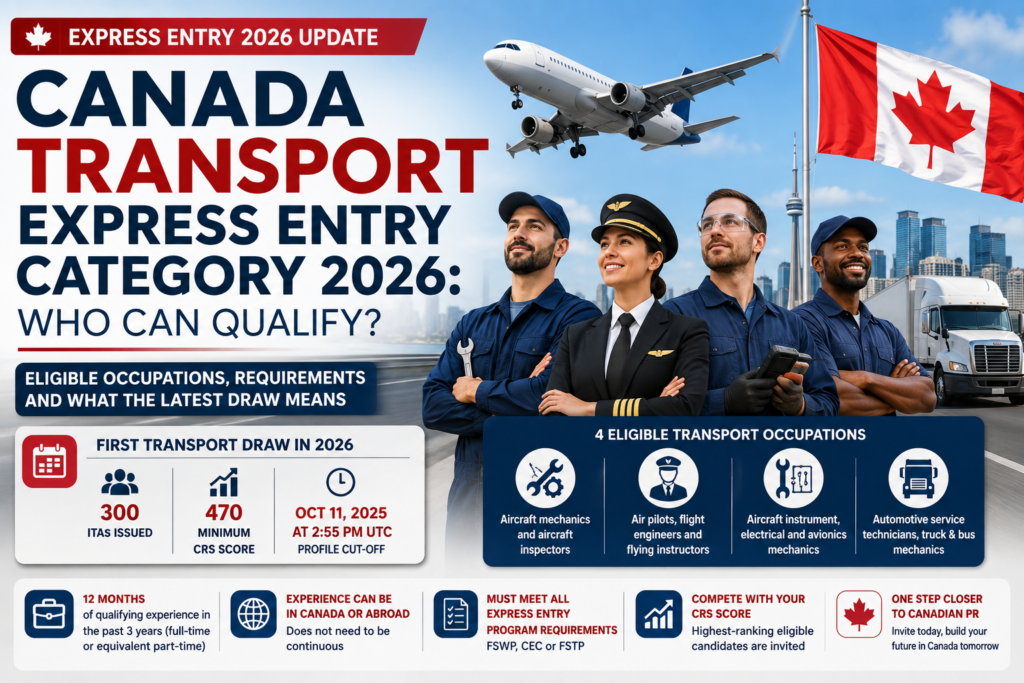
Eligible Occupations, Work Experience Requirements and What the Latest Draw Means
Canada’s Express Entry system has opened another potential route to permanent residence for certain transportation professionals.
On August 7, 2026, Immigration, Refugees and Citizenship Canada (IRCC) held its first Express Entry draw under the renewed Transport occupations category, issuing 300 Invitations to Apply (ITAs) for permanent residence.
The minimum CRS score in that draw was 470. Candidates also needed to have created their Express Entry profile before 2:55 p.m. UTC on October 11, 2025, according to the draw information reported following the selection.
The return of the Transport category is significant for eligible workers, particularly because the current category is much narrower than many people may assume.
If you work in transportation, having a transport-related job does not automatically make you eligible.
Under the current 2026 category, IRCC lists four specific occupations.
What Is the Transport Express Entry Category?
The Transport occupations category is one of Canada’s current category-based Express Entry selection categories.
Category-based selection allows IRCC to invite candidates who meet specific economic priorities in addition to the normal Express Entry requirements.
IRCC currently lists 10 categories, including:
- French-language proficiency
- Healthcare and social services occupations
- STEM occupations
- Trade occupations
- Education occupations
- Transport occupations
- Physicians with Canadian work experience
- Senior managers with Canadian work experience
- Researchers with Canadian work experience
- Skilled military recruits
Category-based selection does not replace Express Entry eligibility. A candidate must still be eligible for one of the three programs managed through Express Entry before they can be considered in a category-based draw.
What Happened in the August 7, 2026 Transport Draw?
The first Transport category draw of 2026 took place on August 7.
IRCC issued:
300 Invitations to Apply
The minimum CRS score was:
470
The profile creation cut-off was:
October 11, 2025, at 2:55 p.m. UTC
This was the first Transport-specific Express Entry selection under the current version of the category.
The draw was also notable because the Transport category had not been used for Express Entry selections for more than two years before its return in 2026.
Which Transport Jobs Qualify for Express Entry in 2026?
This is one of the most important things transportation workers need to understand.
The current IRCC list contains four occupations:
| Occupation | NOC 2021 | TEER |
|---|---|---|
| Aircraft mechanics and aircraft inspectors | 72404 | 2 |
| Air pilots, flight engineers and flying instructors | 72600 | 2 |
| Aircraft instrument, electrical and avionics mechanics, technicians and inspectors | 22313 | 2 |
| Automotive service technicians, truck and bus mechanics, and mechanical repairers | 72410 | 2 |
This means that the current category is not a general category for everyone working in transportation.
For example, a person may work in logistics, shipping, trucking, dispatching or another transportation-related occupation but still not qualify under the current Transport category.
The occupation must match one of the occupations listed in the applicable IRCC instructions.
Does a Truck Driver Qualify?
This is likely to be one of the biggest questions from applicants.
Under the current 2026 Transport category, truck drivers are not included in the four occupations listed by IRCC.
The listed automotive occupation, NOC 72410, covers automotive service technicians, truck and bus mechanics and mechanical repairers. It does not mean that people who drive trucks automatically qualify.
Therefore, a truck driver should not assume that having truck-driving experience makes them eligible for the Transport category.
They may have other Canadian immigration options, depending on their circumstances, but they should not claim Transport category eligibility simply because their work involves transportation.
What About Truck and Bus Mechanics?
This is different.
Automotive service technicians, truck and bus mechanics, and mechanical repairers are included in the current Transport category under NOC 72410.
A person whose actual occupation falls under this NOC may therefore qualify for consideration under the Transport category if they also meet the required work-experience and Express Entry conditions.
The key issue is the person’s actual occupation and duties, not simply the word “truck” appearing in their job description.
What About Pilots?
Yes.
Air pilots, flight engineers and flying instructors, NOC 72600, are included in the current Transport category.
The occupation is classified as TEER 2 under Canada’s 2021 NOC system.
A pilot must still satisfy the other requirements for the applicable Express Entry program and category.
Being a pilot alone does not guarantee an invitation.
What About Aircraft Mechanics?
Yes.
Aircraft mechanics and aircraft inspectors are included under NOC 72404.
Aircraft instrument, electrical and avionics mechanics, technicians and inspectors are also included under NOC 22313.
This creates two separate opportunities for aviation professionals whose occupations match the listed NOCs.
However, candidates should carefully determine which NOC corresponds to their actual work.
How Much Work Experience Do You Need?
To qualify for the Transport occupations category, IRCC currently requires:
At least 12 months of full-time work experience, or an equivalent amount of part-time experience, within the past three years.
The experience:
- Does not need to be continuous.
- Must be in one of the occupations listed for the category.
- Can have been gained in Canada or abroad.
Candidates must also meet the other requirements specified for the particular Express Entry round.
This is important because some applicants may incorrectly assume that their entire career history can be combined to meet the requirement.
The relevant experience needs to meet the category’s specific conditions.
Does the Work Experience Have to Be in Canada?
No.
For the current Transport category, the required work experience can be acquired in Canada or abroad.
This is significant for transportation professionals living outside Canada.
A qualified aircraft mechanic in Nigeria, for example, may potentially meet the work-experience component using eligible experience gained outside Canada.
However, that does not automatically mean the person will qualify for Express Entry overall.
They must first meet the requirements of one of the three Express Entry programs.
Do You Need Canadian Work Experience?
Not necessarily for the Transport category itself.
The category’s work-experience requirement allows qualifying experience gained either inside or outside Canada.
However, the candidate still needs to qualify for an Express Entry program.
This distinction is extremely important.
There are two separate questions:
Question 1: Does your work experience meet the Transport category requirement?
Question 2: Are you eligible for one of the Express Entry programs?
A “yes” to the first question does not automatically mean a “yes” to the second.
What Are the Three Express Entry Programs?
Express Entry manages applications for three federal economic immigration programs:
- Canadian Experience Class
- Federal Skilled Worker Program
- Federal Skilled Trades Program
IRCC places eligible candidates into the Express Entry pool and assigns them a CRS score.
For a category-based draw, the candidate must first be eligible for one of these programs.
IRCC then identifies candidates in the pool who meet the requirements of the category and ranks them according to their CRS scores.
Does Being Eligible for the Transport Category Guarantee an ITA?
No.
This is perhaps the most important point for prospective applicants.
Category eligibility does not guarantee an Invitation to Apply.
IRCC explains that candidates who meet the category requirements are ranked according to their CRS scores, and the highest-ranking eligible candidates are invited.
For example, suppose 10,000 candidates meet the Transport category requirements.
If IRCC decides to invite only 300 candidates, it will rank eligible candidates and invite the highest-ranking candidates according to the rules of that round.
That is why the CRS remains important.
What Does a CRS Score of 470 Mean?
The August 7 Transport draw had a minimum CRS score of 470.
This means that 470 was the lowest CRS score among the candidates invited in that particular round, subject to the applicable tie-breaking rule.
It does not mean that 470 is the permanent CRS requirement for the Transport category.
The cut-off can change from one draw to another.
For example, if IRCC invites substantially more candidates in a future Transport draw, the cut-off could potentially be lower.
If fewer candidates are invited or the pool is more competitive, the cut-off could be higher.
There is no guaranteed future CRS score.
Why Was the Transport Draw So Significant?
The return of the category gives eligible transportation professionals another targeted selection opportunity.
The Transport category had been removed from category-based selection in 2025 and was reintroduced in 2026 with a different list of occupations.
That means older articles about Canada’s Transport Express Entry category may contain information that no longer applies.
This is especially important when researching eligibility.
An applicant should not rely on a 2023 or 2024 article that lists transportation occupations without checking the current IRCC requirements.
The Current Category Is Much Narrower Than “Transport”
The word “Transport” can be misleading.
A person might reasonably think the category covers:
- Truck drivers
- Taxi drivers
- Delivery drivers
- Dispatchers
- Logistics coordinators
- Railway workers
- Shipping workers
- Bus drivers
- Mechanics
- Pilots
- Aircraft technicians
But the current IRCC list does not include all of these occupations.
The official list currently contains four occupations only.
This is why applicants need to check the NOC rather than relying on the general industry they work in.
Why Your NOC Code Matters
Canada uses the National Occupational Classification (NOC) system to classify occupations.
Your job title alone does not necessarily determine your NOC.
The actual duties and responsibilities of your position matter when determining the appropriate occupational classification.
For example, someone whose job title says “transport technician” should not automatically select a Transport category NOC.
They need to determine which NOC accurately represents their actual work.
Choosing the wrong NOC can create problems later if the information in an Express Entry profile cannot be supported by the applicant’s documents.
What Documents Should Transport Workers Keep?
Applicants should keep evidence that can demonstrate their work experience.
Depending on the circumstances, useful documentation can include:
- Employment reference letters
- Contracts
- Pay statements
- Tax records
- Employment records
- Job descriptions
- Work permits
- Proof of employment dates
- Records showing hours worked
- Professional licences where applicable
- Other documents supporting the claimed employment
The documents should accurately reflect the person’s actual employment.
A reference letter should not be created simply to match an immigration category.
The underlying employment must be genuine and the duties must accurately correspond to the claimed occupation.
Can Experience From Multiple Employers Count?
The category requires at least 12 months of qualifying experience in a single listed occupation, and the experience does not need to be continuous.
This means a candidate may have qualifying periods with different employers, provided the work experience meets the applicable requirements and is in the same listed occupation.
For example, an eligible aircraft mechanic could potentially have qualifying experience from more than one employer.
The important issue is whether the combined experience meets IRCC’s requirements.
Can Part-Time Experience Count?
Yes, the category allows an equivalent amount of part-time experience.
IRCC describes the requirement as at least 12 months of full-time work experience or an equal amount of part-time experience within the previous three years.
Applicants should calculate their experience carefully rather than assuming that any 12-month employment period automatically qualifies.
The number of hours and the nature of the work matter.
Can Work Experience From Outside Canada Count?
Yes.
This is one of the most useful aspects of the current Transport category.
IRCC explicitly states that the required experience can be accumulated in Canada or abroad.
Therefore, qualified transportation professionals outside Canada should not assume that they must first obtain Canadian work experience before they can benefit from the category.
However, they still need to qualify for an Express Entry program.
What Should Transport Workers Outside Canada Do?
If you are outside Canada and work in one of the four eligible occupations, the first step should be an overall Express Entry assessment.
You should determine:
- Your correct NOC.
- Whether you have 12 months of qualifying experience within the past three years.
- Your language-test results.
- Your education credentials.
- Whether you meet the requirements of the Federal Skilled Worker Program or another Express Entry program.
- Your potential CRS score.
- Whether you have other immigration options.
The Transport category should be treated as one component of your immigration strategy, not the entire strategy.
What Should Transport Workers Already in Canada Do?
Workers already in Canada may have additional options depending on their circumstances.
For example, some may qualify for the Canadian Experience Class if they have qualifying Canadian work experience.
Others may have opportunities through a provincial nominee program.
A candidate should therefore compare their options rather than automatically choosing the Transport category.
The best pathway depends on the individual’s complete profile.
What If Your CRS Score Is Below 470?
A score below 470 would not have been sufficient for the August 7 Transport draw.
But this does not mean the candidate can never receive an invitation.
Future Transport draws could have different cut-offs.
Candidates can also explore ways to improve their CRS scores.
These may include:
- Improving language results
- Gaining additional qualifying work experience
- Completing eligible education
- Obtaining a qualifying provincial nomination
- Improving French-language proficiency where applicable
- Reviewing whether a spouse’s profile can contribute additional points
Applicants should focus on legitimate improvements rather than trying to predict the next draw.
What If Your CRS Score Is Exactly 470?
A score of exactly 470 requires particular attention to the tie-breaking rule.
The August 7 draw had a profile creation cut-off of October 11, 2025 at 2:55 p.m. UTC.
A candidate with 470 points who created their profile after the applicable cut-off might not have been invited in that round.
The tie-breaking rule does not give a candidate extra CRS points.
It determines which candidates at the cut-off score are included when the number of invitations is limited.
What Happens If You Receive an ITA?
Receiving an Invitation to Apply is a major step, but it is not the same as receiving permanent residence.
IRCC gives invited candidates 60 days to submit their permanent residence application.
The candidate must provide the required documentation and demonstrate that the information in the application is accurate.
IRCC assesses:
- Program eligibility
- Category eligibility
- Accuracy of the Express Entry profile
- Admissibility
- Supporting documentation
- Other applicable requirements
An applicant should therefore ensure that the information used to obtain the ITA can be supported during the permanent residence application stage.
What If Your Job Is Not on the List?
Do not assume that Canada has no immigration pathway for you.
The Transport category is only one category within Express Entry.
A candidate may qualify through:
- Another Express Entry category
- Canadian Experience Class
- Federal Skilled Worker Program
- Federal Skilled Trades Program
- Provincial Nominee Program
- Another federal or provincial immigration pathway
The fact that your occupation is not included in the Transport category simply means you should examine the other options available to you.
Could the Transport Category Change Again?
Yes.
IRCC monitors and assesses Express Entry categories regularly.
The department says categories are chosen using labour market information and projections, as well as input from provinces, territories and stakeholders.
This means applicants should not assume that today’s list will remain unchanged indefinitely.
Canada’s labour market needs can change, and the government can modify its immigration priorities.
What Does the August 2026 Draw Tell Us About Express Entry?
The Transport draw is also useful for understanding how Canada’s Express Entry system is evolving.
In 2026, IRCC has been using a mixture of:
- Program-specific draws
- Category-based draws
- Canadian Experience Class selections
- Provincial Nominee Program selections
- French-language selections
- Occupation-specific selections
The Transport draw was one of several targeted selections rather than a general Express Entry draw.
This reinforces an important point for applicants:
Express Entry is no longer simply about having a high CRS score.
Your eligibility for a particular program or category can determine which invitation rounds you can be considered for.
Common Mistakes Transport Workers Should Avoid
Assuming every transport job qualifies
It does not.
The current category contains four occupations.
Assuming truck drivers qualify
Truck drivers are not among the four occupations currently listed under the Transport category.
Truck and bus mechanics, however, can qualify if their occupation corresponds to NOC 72410 and they meet the other requirements.
Using the wrong NOC
A job title does not automatically determine your NOC.
Your actual duties matter.
Assuming 12 months of any work is enough
The experience must be in an occupation listed for the category and meet IRCC’s requirements.
Assuming the 470 CRS cut-off will remain
The August 7 result is one draw.
Future cut-offs can change.
Ignoring the basic Express Entry requirements
Category eligibility does not replace eligibility for an Express Entry program.
Relying on old articles
The current Transport category was revised, so older lists of eligible occupations may no longer be accurate.
A Simple Example
Consider a Nigerian aircraft mechanic who has worked for 18 months during the past three years.
Suppose the person’s duties correspond to NOC 72404.
The person may meet the Transport category’s occupation and work-experience requirements because aircraft mechanics and aircraft inspectors are currently listed, and the experience can be gained outside Canada.
But the person would still need to qualify for an Express Entry program and meet the other requirements.
Now consider a Nigerian long-haul truck driver with three years of experience.
The person may have substantial transportation experience, but truck driving is not one of the four occupations currently listed under the Transport category.
That person should therefore investigate other Canadian immigration pathways rather than assuming the Transport category applies.
Is the Transport Category a Good Opportunity?
For eligible applicants, it can be.
The August 7 draw is particularly notable because the CRS cut-off of 470 was considerably lower than the CRS scores seen in recent Canadian Experience Class and Provincial Nominee Program draws.
However, comparing different Express Entry categories directly can be misleading.
A CEC draw and a Transport draw select different groups of candidates.
The fact that one category has a lower cut-off does not mean every applicant can access it.
Final Thoughts
The Canada Transport Express Entry category 2026 gives certain transportation professionals another opportunity to pursue permanent residence.
But the category is narrower than its name might suggest.
At present, IRCC lists four eligible occupations:
- Aircraft mechanics and aircraft inspectors
- Air pilots, flight engineers and flying instructors
- Aircraft instrument, electrical and avionics mechanics, technicians and inspectors
- Automotive service technicians, truck and bus mechanics, and mechanical repairers
Applicants also need at least 12 months of qualifying work experience within the past three years, or an equivalent amount of part-time experience. The experience can be in Canada or abroad.
The August 7, 2026 draw issued 300 ITAs at a CRS cut-off of 470, making it an important development for eligible transportation professionals.
However, the draw should not be interpreted as a promise of future invitations at 470.
The Transport category is only one part of Canada’s Express Entry system, and applicants must still qualify for one of the underlying Express Entry programs.
If your occupation is on the current list, the next step is not simply to wait for another draw.
You should determine your correct NOC, verify your qualifying work experience, calculate your CRS score and assess whether you meet the requirements of an Express Entry program.
If your occupation is not on the list, do not assume that Canada has no pathway for you. Other Express Entry categories, provincial programs and immigration pathways may still be available.
Need Help With Your Canada Immigration Plans?
Worldbridge Immigration helps individuals and families assess Canadian immigration options and understand the requirements that apply to their circumstances.
If you work in aviation, automotive repair or another transportation-related field and want to know whether your occupation could support a Canadian permanent residence application, a detailed assessment can help you identify the pathways available to you.