
What the Latest IRCC Consultation Could Mean for Future Permanent Residence Applicants
Canada is reviewing the economic priorities that could shape Express Entry categories for 2027.
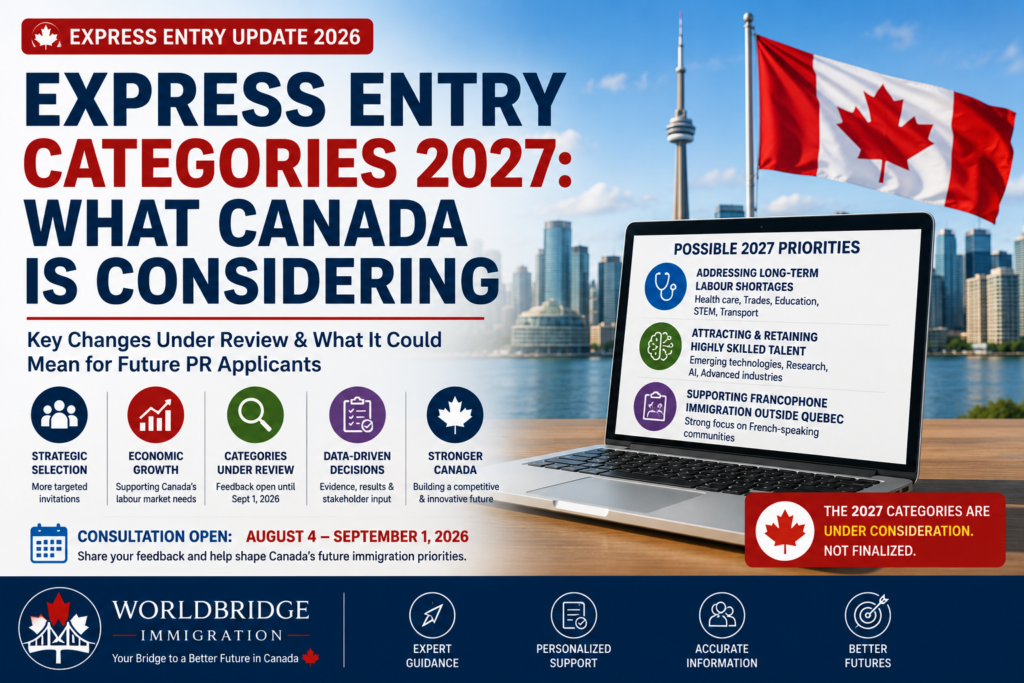
Immigration, Refugees and Citizenship Canada (IRCC) opened a public consultation on August 4, 2026, asking stakeholders and members of the public for their views on the economic priorities and categories that should be considered for category-based Express Entry selection in 2027. The consultation is open until September 1, 2026.
For people planning to immigrate to Canada through Express Entry, this is an important development. However, applicants should be careful about what the announcement actually means.
Canada has not yet announced the final 2027 Express Entry categories.
Instead, IRCC is gathering evidence and feedback before deciding which priorities and categories should be established.
That means today’s applicants should understand both the categories that exist in 2026 and the possible direction of Express Entry in 2027.
What Is Express Entry?
Express Entry is Canada’s online system for managing applications for three federal economic immigration programs:
- Canadian Experience Class
- Federal Skilled Worker Program
- Federal Skilled Trades Program
The system allows eligible candidates to create a profile and enter a pool of candidates.
Candidates are ranked using the Comprehensive Ranking System, commonly called the CRS.
When IRCC holds an invitation round, candidates with the highest rankings among those eligible for that particular round may receive an Invitation to Apply (ITA) for permanent residence.
Express Entry therefore does not operate as a simple first-come, first-served system.
Your eligibility, CRS score, work experience, language ability and other factors can affect your chances of receiving an invitation.
What Is Category-Based Selection?
Category-based selection was introduced in Express Entry in 2023.
It gives IRCC another way to select candidates whose skills, training, work experience or language abilities are linked to specific economic priorities.
Instead of considering every candidate in exactly the same way, IRCC can hold a category-based invitation round for candidates who meet the requirements of a particular category.
However, category-based selection does not replace the basic Express Entry requirements.
A candidate must still be eligible for one of the three federal programs managed through Express Entry and meet the requirements established for the specific invitation round.
What Is Canada Considering for 2027?
For 2027, IRCC says it is considering three broad economic priorities:
- Addressing long-term labour shortages
- Attracting and retaining highly skilled talent
- Supporting economic growth through Francophone immigration outside Quebec
These priorities are still under consideration.
The final categories will be established later through the appropriate process.
1. Addressing Long-Term Labour Shortages
Canada continues to experience labour shortages in several important areas.
IRCC says its existing category-based selection has focused on sectors including:
- Health care
- Skilled trades
- Education
- STEM
- Transport
These shortages continue to affect Canada’s economy, housing supply and access to services.
For 2027, IRCC is considering whether and how Express Entry should continue to address these shortages.
However, there is an important change in the way IRCC is approaching the issue.
Canada May Narrow Some Labour-Shortage Categories
IRCC says it is considering narrowing the number or eligibility of categories aimed at addressing labour shortages so that category-based selection can have a more strategic focus.
This is important for applicants who currently work in one of Canada’s 2026 priority occupations.
Being eligible for a category in 2026 does not mean the same occupation will necessarily remain a priority in 2027.
Applicants should therefore avoid making long-term immigration decisions based entirely on the assumption that their current Express Entry category will continue unchanged.
Why Is Canada Considering Narrower Categories?
IRCC has to balance immigration selection with Canada’s broader immigration levels, labour market needs and domestic capacity.
The department says it is examining whether Express Entry should address every identified labour shortage or whether other tools may be more appropriate in some circumstances.
Those alternatives could include:
- Domestic training
- Upskilling
- Retraining
- Regional immigration programs
- Temporary immigration programs
- Federal pilots
This means category-based Express Entry is only one of the tools Canada can use to address labour shortages.
2. Attracting and Retaining Highly Skilled Talent
Another major area under consideration is highly skilled international talent.
Canada wants to attract people whose skills, education and experience can contribute to economic growth and competitiveness.
IRCC says it is considering how Express Entry could support government strategies designed to attract and retain highly skilled professionals.
This could be particularly relevant to people working in areas such as:
- Emerging technologies
- Health care
- Skilled trades
- Research
- Artificial intelligence
- Advanced industries
However, these areas should currently be viewed as areas of policy consideration, not confirmed 2027 Express Entry categories.
Artificial Intelligence Could Become Increasingly Important
Artificial intelligence is one area specifically mentioned in IRCC’s consultation.
Canada’s National Artificial Intelligence Strategy recognizes AI talent as an important strategic asset.
IRCC also points to Canada’s efforts to make it easier for highly skilled AI professionals to enter Canada, including through the Global Talent Stream.
This does not mean there is currently a separate “AI Express Entry category for 2027.”
Rather, it shows that AI and other emerging technologies are part of the broader talent-attraction strategy that IRCC may consider when developing future Express Entry priorities.
Researchers and Global Talent
Canada is also considering how immigration can help attract leading international researchers.
IRCC specifically references the Canada Global Impact+ Research Talent Initiative, which aims to recruit leading international researchers in critical fields and strengthen Canada’s position in scientific innovation.
This could make research and advanced technical expertise increasingly relevant to Canada’s economic immigration strategy.
Again, however, applicants should distinguish between a government strategy being considered as an input and an officially established Express Entry category.
What About H-1B Workers in the United States?
IRCC’s consultation also mentions a commitment in Budget 2025 to launch an accelerated pathway for H-1B visa holders based in the United States and working in specialty occupations.
The stated objective is to attract top talent in areas such as:
- STEM
- Health care
- Research
- Advanced industries
IRCC says this initiative is part of the broader context it will consider when assessing future Express Entry categories.
This does not mean that every H-1B worker automatically qualifies for Express Entry or that a dedicated 2027 category has already been created.
3. Francophone Immigration Outside Quebec
French-language immigration remains another major priority.
Canada wants to increase the number of French-speaking permanent residents settling outside Quebec.
IRCC says category-based selection remains an important mechanism for supporting this objective.
For 2027, IRCC is considering maintaining the focus on Francophone immigration.
The 2026–2028 Immigration Levels Plan sets targets for French-speaking permanent residents outside Quebec at:
- 9% in 2026
- 9.5% in 2027
- 10.5% in 2028
Canada has also committed to increasing the target to 12% by 2029.
For applicants with strong French-language abilities, this is an important area to watch.
Why French Could Matter More to Express Entry Candidates
French-language proficiency can provide a separate route to category-based selection.
Under the current French-language category, candidates need French-language test results showing at least NCLC 7 in all four language abilities, along with the other requirements for the relevant round.
This makes French an increasingly valuable skill for people planning to immigrate to Canada.
An applicant who has both strong English and French abilities may also be eligible for more than one category depending on their work experience and other circumstances.
What Categories Exist in 2026?
While the 2027 categories are still under consultation, applicants should understand what Canada is prioritizing in 2026.
IRCC’s current 2026 categories include:
Labour-shortage categories
- Education occupations
- Trades occupations
- Transport occupations
- Health care and social services occupations
- STEM occupations
Categories focused on attracting and retaining talent
- Physicians with Canadian work experience
- Researchers with Canadian work experience
- Senior managers with Canadian work experience
- Skilled military recruits with a job offer from the Canadian Armed Forces
Francophone immigration
- French-language proficiency
IRCC also continues to focus on the Canadian Experience Class in 2026 as part of its effort to transition temporary residents to permanent residence.
How Successful Have the Current Categories Been?
The numbers from previous years show that category-based selection can have a significant impact on Express Entry invitations.
In 2025, IRCC reports that category-eligible candidates received:
- 19,200 health-care invitations
- 9,200 education invitations
- 5,942 STEM invitations
- 4,589 trades invitations
- 50,701 French-language category invitations
These figures exclude Provincial Nominee Program ITAs and a candidate can be eligible for more than one category, so they should not be interpreted as a simple count of unique people selected through each category.
The French-language category was particularly significant in 2025, accounting for 49.2% of the total category-eligible invitations reported by IRCC.
Does Being in a 2026 Category Guarantee an Invitation in 2027?
No.
This is one of the biggest misconceptions applicants should avoid.
Express Entry categories can change because Canada’s economic priorities change.
IRCC explicitly reviews categories regularly so the system can respond to changing labour market needs.
Therefore:
2026 category ≠ guaranteed 2027 category.
An applicant should not assume that their occupation will remain on the list simply because they qualify today.
Does Category Eligibility Guarantee an ITA?
No.
Meeting the requirements of a category does not automatically guarantee an Invitation to Apply.
IRCC ranks eligible candidates in the pool and invites the highest-ranking candidates in a category-based round.
Your CRS score can therefore remain important even if you qualify for a category.
For example, two candidates may both qualify for the same occupation-based category, but the candidate with the stronger ranking may receive an invitation before the other.
Can You Qualify for More Than One Category?
Yes.
IRCC explains that a candidate can be eligible for more than one invitation round type or category.
For example, someone with strong French-language abilities and eligible work experience in a priority occupation could potentially meet the requirements of both the French-language category and an occupation-based category.
This can give some candidates more than one potential route to selection.
What Does the 2027 Consultation Mean for Applicants?
For applicants, the consultation is mainly a signal about the direction Canada is considering.
It suggests that Canada may place greater emphasis on:
- Strategic labour shortages
- Highly skilled international talent
- French-language immigration
- Skills connected to economic growth
- Talent in emerging and advanced industries
At the same time, applicants should expect that some existing labour-shortage categories could become narrower.
This means that flexibility may become increasingly important.
Should You Wait Until 2027 to Create an Express Entry Profile?
Not necessarily.
If you are already eligible for Express Entry, waiting for the 2027 categories may not be the best strategy.
The current system is still operating.
If you qualify now, you can assess your current options and work on strengthening your profile while monitoring future announcements.
There is no guarantee that waiting will produce a better opportunity.
What Can You Do to Strengthen Your Profile?
Regardless of what happens with the 2027 categories, candidates can work on several factors within their control.
Improve Your Language Results
Strong language ability can significantly affect your Express Entry profile.
If you speak French, consider whether improving your French results could make you eligible for the French-language category.
Gain Eligible Work Experience
Work experience can matter both for Express Entry program eligibility and for category-based selection.
Keep accurate records of your employment, including dates, duties and employers.
Check Your NOC
Do not choose an occupation based solely on your job title.
Your actual duties and responsibilities should correspond with the appropriate NOC.
Improve Your CRS Score
Candidates should regularly review their CRS profile to identify legitimate opportunities to improve their ranking.
Depending on your circumstances, this could involve language results, education, work experience or other factors recognized by the CRS.
Consider Canadian Experience
Canadian work experience can be particularly important under Canada’s current 2026 approach, which includes a focus on Canadian Experience Class candidates.
However, candidates should assess their eligibility under the current rules rather than assuming Canadian experience alone guarantees an invitation.
What Should Applicants Not Do?
Applicants should avoid making major immigration decisions based on rumours about future categories.
Do not:
- Assume an occupation has already been selected for 2027.
- Quit a job because you expect a new Express Entry category.
- Pay someone who guarantees an ITA because of a supposed upcoming category.
- Assume a 2026 category will automatically continue.
- Ignore your current Express Entry options while waiting for 2027.
- Treat consultation proposals as final immigration rules.
The 2027 categories have not yet been finalized.
When Will We Know the 2027 Categories?
The current consultation is open until September 1, 2026.
IRCC will consider feedback from the public and stakeholders, engage federal, provincial and territorial partners, and review labour market information and past results before final decisions are made.
IRCC says new categories are posted on its website once they have been approved by the Minister.
Until that happens, applicants should treat proposed priorities as possibilities rather than confirmed pathways.
What Does This Mean for People Outside Canada?
People living outside Canada should not assume that category-based selection is only useful for people already in Canada.
Express Entry can be used by eligible candidates living abroad as well as many temporary residents already in Canada.
However, the current data shows that a significant share of category-eligible candidates have Canadian experience or are already in Canada, depending on the category.
Applicants outside Canada should therefore assess the full Express Entry system rather than focusing exclusively on category-based draws.
What Does This Mean for International Students?
International students and former international students should pay close attention to Canada’s evolving approach.
IRCC says Express Entry is used by many temporary residents, including former international students and temporary workers, and Canada’s 2026 approach includes a focus on transitioning temporary residents to permanent residence through the Canadian Experience Class.
However, studying in Canada does not automatically lead to permanent residence.
Students should consider their future immigration options before choosing a program and should monitor the rules that will apply when they graduate.
The Bigger Picture
The consultation is about more than changing a list of occupations.
It reflects a broader question about what Canada wants its economic immigration system to accomplish.
Canada is trying to balance several objectives:
- Addressing labour shortages
- Attracting global talent
- Supporting economic growth
- Maintaining sustainable immigration levels
- Supporting French-language communities
- Transitioning some temporary residents to permanent residence
- Responding to changing labour market conditions
Express Entry is increasingly being used as one part of that broader strategy.
Final Thoughts
The Express Entry categories 2027 are not finalized yet, but Canada’s current consultation provides useful clues about where the system may be heading.
IRCC is considering continued attention to long-term labour shortages, a stronger approach to attracting and retaining highly skilled international talent, and continued support for Francophone immigration outside Quebec.
At the same time, Canada is considering narrowing some labour-shortage categories so that selection can be more strategically focused.
For applicants, the best response is not to wait for a rumoured new category.
Instead, understand the rules that apply today, strengthen the parts of your Express Entry profile that you can control, and monitor official announcements as Canada moves toward its 2027 selection framework.
Most importantly, remember that being discussed is not the same as being approved.
Until IRCC publishes the final 2027 categories, applicants should treat the current consultation as an indication of possible future priorities, not as a guarantee of future invitations.
Need Help With Your Canada Immigration Plans?
Worldbridge Immigration helps individuals and families understand Canadian immigration pathways, assess their options and prepare for the application process.
If you are considering Express Entry and want to understand how your occupation, work experience, language ability and CRS profile may affect your options, professional guidance can help you make a more informed decision.