What Spouses of Foreign Workers and International Students Need to Know
Moving to Canada for work or study is often a family decision. For many couples, one of the first questions is whether the accompanying spouse or common-law partner will also be allowed to work.
In 2026, the answer is not simply yes or no.
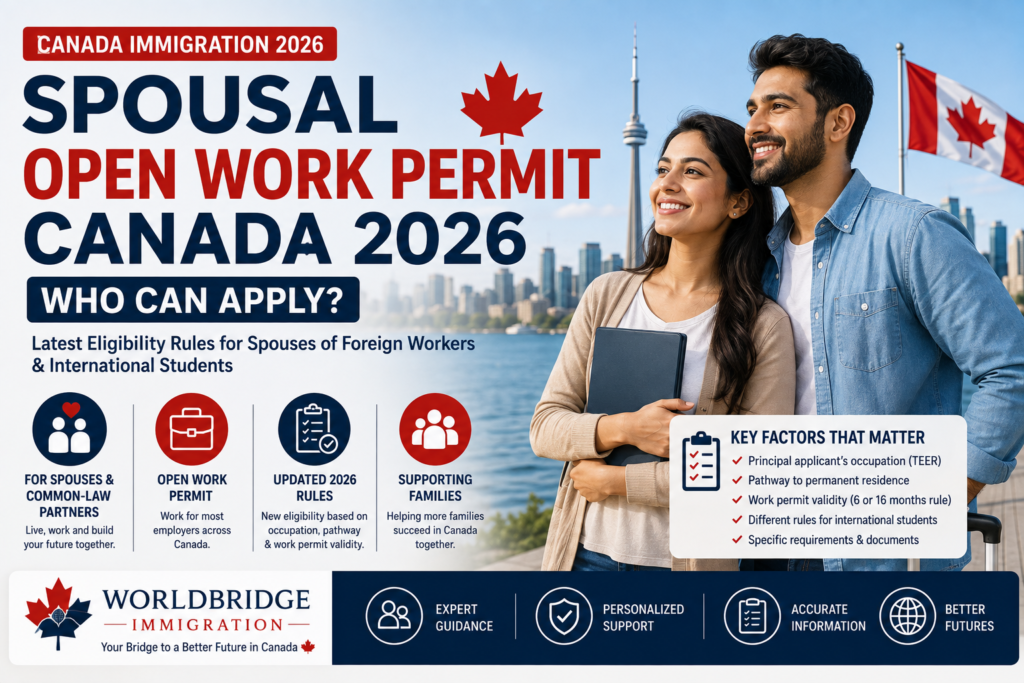
Canada’s rules for spousal open work permit Canada 2026 applications depend on several factors, including the principal applicant’s occupation, immigration pathway, type of work permit and how long that permit remains valid.
A spouse or common-law partner must generally apply for their own work permit. In eligible situations, that permit can be an open work permit, allowing them to work for most employers in Canada without being tied to one specific employer.
What Is a Spousal Open Work Permit?
An open work permit allows an eligible foreign national to work for most employers in Canada without needing a job offer from a specific employer before applying.
For spouses and common-law partners, eligibility is based on the immigration status and circumstances of the principal applicant.
This means that being married to someone who works or studies in Canada does not automatically give the spouse the right to work.
The spouse must qualify under an applicable immigration category and must meet the requirements for a work permit.
Can a Spouse Still Get an Open Work Permit in 2026?
Yes, but eligibility has become more limited.
IRCC currently separates family members of foreign workers into different groups. The applicable rules can depend on whether the principal applicant:
- Has already applied for permanent residence through an eligible economic program.
- Is on a qualifying pathway to permanent residence but has not yet applied.
- Works in a high-skilled occupation.
- Works in a low-skilled occupation.
- Works under a special immigration arrangement.
- Is an international student.
The occupation is particularly important for some temporary foreign workers because only certain TEER 2 and TEER 3 occupations qualify, while TEER 0 and TEER 1 occupations are generally treated differently under the current measure.
Spouses of Workers Who Have Applied for Permanent Residence
One of the important routes is for temporary foreign workers who have already applied for permanent residence through certain eligible economic immigration programs or pilots.
These programs include pathways such as:
- Canadian Experience Class
- Federal Skilled Worker Program
- Federal Skilled Trades Program
- Provincial Nominee Program
- Atlantic Immigration Program
- Agri-Food Pilot
- Rural Community Immigration Pilot
- Francophone Community Immigration Pilot
- Start-up Visa Program
- Certain Quebec-related programs
The full list and applicable conditions should be checked against the current IRCC requirements because eligibility differs between programs.
The principal applicant generally needs to meet key requirements
Under this measure, the principal applicant must generally:
- Hold a valid work permit or be approved for one.
- Have a work permit valid for at least six months after IRCC receives the family member’s application.
- Live and work, or plan to live and work, in Canada.
- Have obtained the work permit because of an eligible economic-class permanent residence program or pilot.
The spouse or other eligible family member must also meet the applicable work permit requirements and prove the qualifying family relationship.
What If the Worker Has Not Applied for Permanent Residence Yet?
There is also a separate measure for certain workers who are on a qualifying pathway to permanent residence but have not yet submitted their permanent residence application.
This route is narrower.
For example, IRCC states that certain workers in TEER 4 or 5 occupations may qualify if they are on an eligible pathway to permanent residence and meet the other requirements.
The eligible pathways include the Provincial Nominee Program, Atlantic Immigration Program, Agri-Food Pilot, Start-up Visa Program and certain Quebec and Yukon pathways.
The distinction matters because simply saying, “I plan to apply for PR later,” is not enough.
The worker must actually meet the conditions of an eligible pathway.
Spouses of High-Skilled Workers
For high-skilled temporary foreign workers who are not on one of the specified pathways to permanent residence, only certain spouses and common-law partners may qualify under the current measure.
IRCC defines high-skilled work for this purpose as employment in:
- TEER 0
- TEER 1
- Selected TEER 2 occupations
- Selected TEER 3 occupations
For the principal applicant, the work permit or authorization to work generally needs to remain valid for at least 16 months after IRCC receives the spouse’s open work permit application. There are specific exceptions, including certain foreign-trained health professionals recruited by Quebec.
This 16-month requirement is particularly important for families planning their applications.
If the principal worker’s permit is expiring soon, the spouse may not qualify under this particular route.
Which TEER 2 and TEER 3 Jobs Can Qualify?
Not every TEER 2 or TEER 3 occupation qualifies under the current rules.
IRCC has published specific lists.
Examples of eligible TEER 2 occupations include certain:
- Medical technologists and technicians
- Licensed practical nurses
- Dental hygienists and dental therapists
- Early childhood educators and assistants
- Electricians
- Plumbers
- Carpenters
- Welders
- Heavy-duty equipment mechanics
- Aircraft mechanics
- Construction supervisors
- Railway and transport supervisors
Examples of eligible TEER 3 occupations include certain:
- Dental assistants
- Medical laboratory assistants
- Nurse aides
- Pharmacy assistants
- Teacher assistants
- Concrete finishers
- Roofers
- Painters and decorators
- Transport truck drivers
- Bus and transit operators
- Heavy equipment operators
- Miners
- Oil and gas well drillers
This is only a selection. Applicants should check the exact NOC code and duties against the current IRCC list rather than relying on a job title alone.
Why Your NOC Code Matters
Two jobs can have similar titles but fall under different National Occupation Classification (NOC) codes.
For immigration purposes, the actual occupation and duties matter.
For example, someone who describes themselves simply as a “technician” should not assume that their occupation qualifies because another technician appears on an eligible list.
Applicants should identify the NOC that accurately reflects their employment and then check whether that specific occupation appears in the applicable IRCC category.
What About Spouses of International Students?
The rules are different for international students.
Not every spouse of an international student automatically qualifies for an open work permit.
IRCC currently says that spouses and common-law partners of some international students may qualify. The eligibility rules include requirements relating to the student’s program of study. For example, eligible students can include those studying in a master’s program lasting 16 months or longer or in a doctoral program.
This means a student enrolled in a short college program should not assume that their spouse will automatically receive an open work permit.
The student’s specific program must be checked against the current IRCC requirements.
What If the Student Is Applying for a PGWP?
This situation requires particular attention.
IRCC’s current instructions state that a family member may apply after the student submits a Post-Graduation Work Permit application, but if the PGWP application is still awaiting a decision, the spouse’s application can be affected.
IRCC notes that the PGWP must be approved before the family member’s open work permit application can be processed in the relevant situation.
Therefore, families should not assume that submitting a PGWP application automatically guarantees approval of the spouse’s work permit.
What If the Principal Applicant Is a Low-Skilled Worker?
The rules are more restrictive.
As of January 21, 2025, family members of low-skilled workers who are not on an eligible pathway to permanent residence are generally not eligible for a new open work permit under this measure.
However, some family members already in Canada may be able to extend an existing open work permit in specific circumstances.
This is why the phrase “spouse of a foreign worker” is not enough to determine eligibility.
The worker’s occupation, immigration pathway and existing permit all matter.
What If the Worker Is on a Pathway to Permanent Residence?
This can significantly change the situation.
IRCC has a separate category for workers who are on certain pathways to permanent residence.
For qualifying workers who have not yet applied for PR, the rules can allow their family members to qualify for an open work permit if the required conditions are met.
For workers who have already submitted their PR application through an eligible economic program, a different set of requirements applies.
Understanding which stage you are at is therefore important.
How Long Must the Principal Work Permit Be Valid?
This depends on the category.
For certain workers who have already applied for permanent residence, IRCC requires the principal applicant’s work permit to be valid for at least six months after the spouse’s application is received.
For certain high-skilled workers who are not on an eligible PR pathway, the requirement is generally 16 months of remaining validity when the spouse applies, subject to specific exceptions.
This difference is easy to miss.
A family should therefore determine which category applies before assuming that a spouse qualifies.
What If the Spouse Is Already in Canada?
A spouse already in Canada may still be able to apply if they meet the applicable requirements.
IRCC says that family members in Canada must generally have valid temporary resident status, have applied to extend their status before it expired and therefore have maintained status, or be eligible for restoration as a visitor, worker or student.
The spouse should therefore pay close attention to the expiry date of their current status.
Waiting until status has already expired can create additional complications.
Can Dependent Children Get Open Work Permits Too?
Not always.
The rules for dependent children have also become more restricted.
Under some economic-class pathways, eligible family members can include dependent children. However, for certain temporary foreign worker categories, dependent children are no longer eligible for a new open work permit under the family-member measure.
The exact result depends on the principal applicant’s pathway and circumstances.
Families should therefore check each family member’s eligibility individually rather than assuming that every accompanying family member receives the same work authorization.
What Documents Will the Spouse Need?
The exact document checklist depends on the application.
Applicants should generally be prepared to provide evidence of:
- The marriage or common-law relationship.
- The principal applicant’s work permit.
- The principal applicant’s employment.
- The principal applicant’s occupation and NOC.
- The principal applicant’s immigration pathway, where relevant.
- The spouse’s identity and temporary status.
- Other supporting information required by IRCC.
IRCC emphasizes that applicants should always check the document requirements for their specific program rather than relying on a generic list.
Common Mistakes to Avoid
Assuming marriage automatically gives work authorization
It does not.
The spouse generally needs their own work permit and must qualify under the relevant rules.
Looking only at the job title
A job title alone does not establish eligibility.
The correct NOC and actual job duties matter.
Ignoring the 6-month or 16-month requirement
Depending on the category, the principal applicant’s remaining work-permit validity can be critical.
Assuming every TEER 2 or TEER 3 job qualifies
Only selected occupations are included under the current high-skilled worker measure.
Assuming every international student’s spouse qualifies
The student’s program must meet the applicable eligibility requirements.
Waiting until the last minute
Families should review their eligibility well before the principal applicant’s work permit or the spouse’s status expires.
A Simple Example
Consider a worker in Canada who has applied for permanent residence through an eligible economic program.
The worker has a valid work permit and has more than six months remaining on it when their spouse submits an open work permit application.
If the worker and spouse meet the other requirements, the spouse may be eligible for an open work permit under the applicable family-member measure.
Now consider a different worker whose permit has only three months remaining.
The result may be different because the six-month requirement may not be satisfied.
This is why two families with similar jobs can receive different outcomes.
What Should Families Do Before Applying?
Before submitting a spousal open work permit application, consider these steps:
- Identify the principal applicant’s NOC code.
- Determine the TEER category of the occupation.
- Check whether the worker is on a pathway to permanent residence.
- Determine whether the PR application has already been submitted.
- Check the expiry date of the principal applicant’s work permit.
- Check the spouse’s current immigration status if they are already in Canada.
- Review the current IRCC eligibility requirements.
- Prepare relationship and employment documents.
- Do not submit an application based solely on a social media summary of the rules.
Immigration requirements can change, so applicants should verify the applicable rules immediately before applying.
What If Your Spouse Is Not Eligible?
Not qualifying for a spousal open work permit does not necessarily mean your spouse cannot come to Canada.
Depending on the circumstances, the family member may qualify for another type of work permit, a study permit or visitor status.
The correct option depends on the person’s circumstances and what they intend to do in Canada. IRCC specifically notes that family members who are not eligible for an open work permit may have other temporary-residence options.
Final Thoughts
The spousal open work permit Canada 2026 rules are more selective than many applicants may expect.
A spouse does not automatically receive an open work permit simply because their partner works or studies in Canada.
For foreign workers, eligibility can depend on the worker’s occupation, NOC and TEER category, permanent residence pathway, work permit validity and other circumstances. For international students, the student’s program of study is also important.
The safest approach is to determine the exact category that applies to your family before submitting an application.
If your spouse is planning to work in Canada, do not make travel, employment or financial decisions based on the assumption that an open work permit will automatically be approved.
Need Help With Your Canada Immigration Plans?
Worldbridge Immigration helps individuals and families understand Canadian immigration pathways, prepare supporting documents and navigate work permit and permanent residence applications.
If you are planning to bring your spouse to Canada or want to determine whether your family may qualify for an open work permit, professional guidance can help you understand the requirements that apply to your specific situation.