

What the policy signals really say (students + work permits), and what it means for you
Canada isn’t “ending” temporary immigration. But it is clearly changing the rules of the game: fewer new temporary arrivals, tighter eligibility, more compliance checks, and a stronger push to restore balance between population growth and housing/service capacity.
This article breaks down the trend in a simple, balanced way—using official signals, not rumours.
1) First, what “temporary residents” really means (and why it’s now the focus)
When people say temporary residents, they usually mean:
- International students (study permits)
- Temporary foreign workers (work permits)
- Visitors (visitor visas/eTAs)
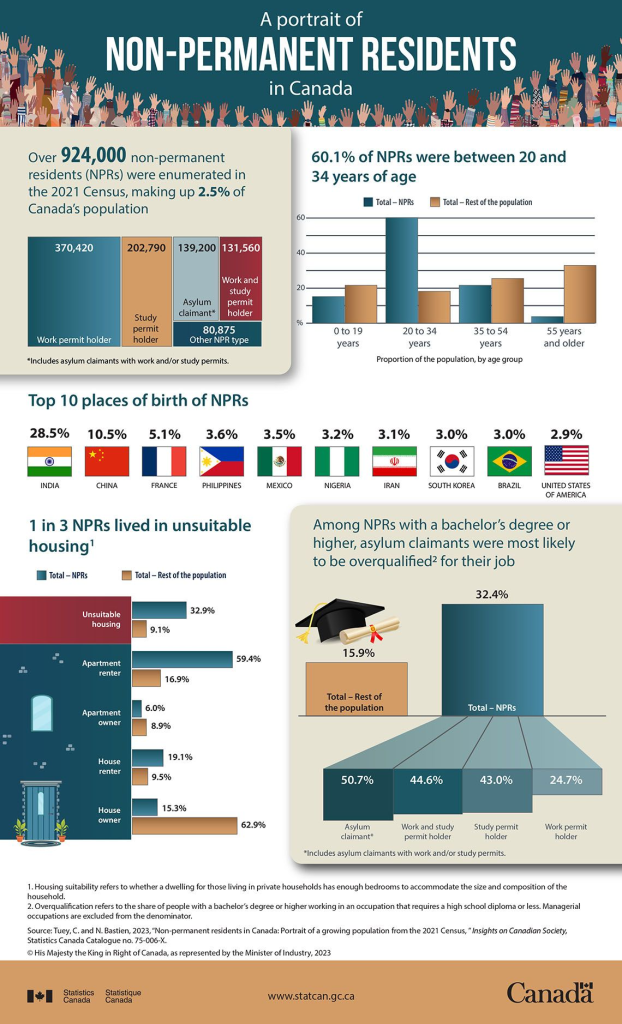
In Canada’s population statistics, you’ll also see the term non-permanent residents (NPRs) (Statistics Canada’s measure). NPRs include permit holders and some other groups. Canada is now watching NPR levels much more closely, and that is shaping policy.
2) The strongest “proof” that Canada is tightening temporary inflows
A) The government now sets explicit targets for new temporary arrivals
This is the big change many people miss.
On IRCC’s Levels Plan page, Canada now publishes targets not just for PR, but also for new temporary resident arrivals—split into:
- new student arrivals
- new temporary worker arrivals
For 2026, IRCC lists (among other figures):
- 155,000 new student arrivals (noted as 49% fewer than last year’s target)
- 230,000 new temporary worker arrivals (noted as 37% fewer than last year’s target)
- 380,000 new permanent residents
And in the supplementary 2026–2028 information, Canada states a clear goal: reduce the temporary population to less than 5% of the total population by the end of 2027, with new temporary resident arrival targets of 385,000 (2026) and 370,000 (2027 and 2028). Source
What this means (in plain language):
Canada is no longer letting temporary numbers “float.” It is actively managing them like a quota—because temporary resident growth has been one of the fastest drivers of population pressure.
B) International students: the cap system is now structural, not “one-time”
Canada introduced a cap approach and now uses provincial/territorial allocations and attestation letters (PAL/TAL) as part of the study permit process.
Key official signals:
- IRCC planned to issue a total of 437,000 study permits in 2025 (a decrease from 2024) under the cap system. Source
- For 2026, IRCC announced 309,670 study permit application spaces available under the cap for PAL/TAL-required students (this is the maximum number IRCC will accept for processing for that category). Source
- IRCC also explains the validity periods for PAL/TAL for the 2025 and 2026 cap years. Source
Analytical takeaway:
When a government builds a whole allocation + attestation system across provinces, that’s not a “temporary crackdown.” That’s a redesigned pipeline.
C) PGWP is becoming more selective (not “removed,” but more controlled)
Canada is not cancelling PGWP broadly, but it is tightening who qualifies and what proof is required.
Official signals include:
- Language proof requirement for most PGWP applicants (policy change effective November 1, 2024)
- Field-of-study eligibility lists (CIP codes) for some programs, with updates and periodic revisions by IRCC
Analytical takeaway:
This is “labour-market alignment” in action: Canada is trying to reduce the number of graduates who cannot transition smoothly into in-demand work.
D) Temporary foreign worker rules: more guardrails, especially in low-wage streams
On the work side, tighter rules are showing up in the Temporary Foreign Worker Program (TFWP), especially for low-wage roles.
Official sources highlight:
- A 10% cap on the proportion of TFWs that can be hired in low-wage positions at a work location (with some exemptions).
- Policy tightening from Sept 26, 2024 included:
- cap reduced (20% → 10% in many cases),
- maximum employment duration reduced (2 years → 1 year),
- refusal to process certain low-wage LMIAs in CMAs with unemployment rate ≥ 6% (with exceptions for key sectors).
Analytical takeaway:
This suggests Canada is trying to limit low-wage temporary growth in places where unemployment is already relatively high—while still protecting sectors it considers essential.
3) So… is Canada “shifting away” from temporary residents?
A balanced answer: Canada is shifting away from uncontrolled temporary growth
It’s not an anti-student or anti-worker agenda. It’s more like:
- “We still need temporary pathways, but not at any cost.”
- “We want better matching, better compliance, and better planning.”
That’s why you see:
- caps and allocations (students),
- extra eligibility layers (PGWP),
- tighter employer rules (TFWP),
- and explicit targets for new temporary arrivals (Levels Plan).
4) The “quiet shift” is also about who gets to stay
A major strategy that can sit behind tighter temporary intake is:
Convert some of the people already in Canada, while slowing new inflows
You’ll see this logic reflected in public policy discussions and in how Canada frames transitions from temporary to permanent status in its immigration communications.
What this means for applicants:
Canada may reduce new temporary entrants, but still keep pathways open for those who:
- are already working/studying in Canada,
- have strong compliance history,
- fit priority occupations,
- and are economically established.
5) What this means for you (practical, helpful guidance)
If you’re planning to come as an international student
What matters more now:
- school choice + program credibility
- clear career pathway (why this program, why Canada, how it fits)
- compliance (study load, work rules, document consistency)
- PGWP eligibility planning from day one (don’t assume it; verify it)
Use IRCC’s official PGWP pages for eligibility rules and updates. See here
If you’re coming as a temporary worker
Expect more scrutiny around:
- job genuineness and employer compliance,
- wage/stream rules (high-wage vs low-wage),
- and regional labour conditions (especially for low-wage LMIA roles).
If you’re already in Canada as a student or worker
This is the group that may benefit most from the new direction—if you’re strategic.
What to do:
- keep your status clean (no unauthorized work, no gaps without explanation),
- document everything properly,
- plan your transition timeline early,
- focus on realistic PR pathways (EE category-based, PNP, sector-specific options, etc.).
6) What to watch next (so you’re not surprised)
If you want to predict the next shift, watch these official indicators:
- IRCC Immigration Levels page + supplementary targets (especially temporary resident targets) See here
- Student cap allocation updates (2025, 2026, etc.) See here
- PGWP eligibility updates (language + field-of-study lists change over time) See here
- Statistics Canada NPR quarterly estimates (this is the “pressure gauge”) See here
Policies are changing fast, and the best pathway depends on your status, documents, and timeline.
If your question requires case-specific guidance, book a consultation with our expert team.