Understanding the Two Main Work Pathways for International Graduates
After graduating in Canada, one of the most common sources of confusion for international students is understanding the difference between work permits. Two of the most discussed options are the Post Graduation Work Permit (PGWP) and the Labour Market Impact Assessment (LMIA)-based work permit.
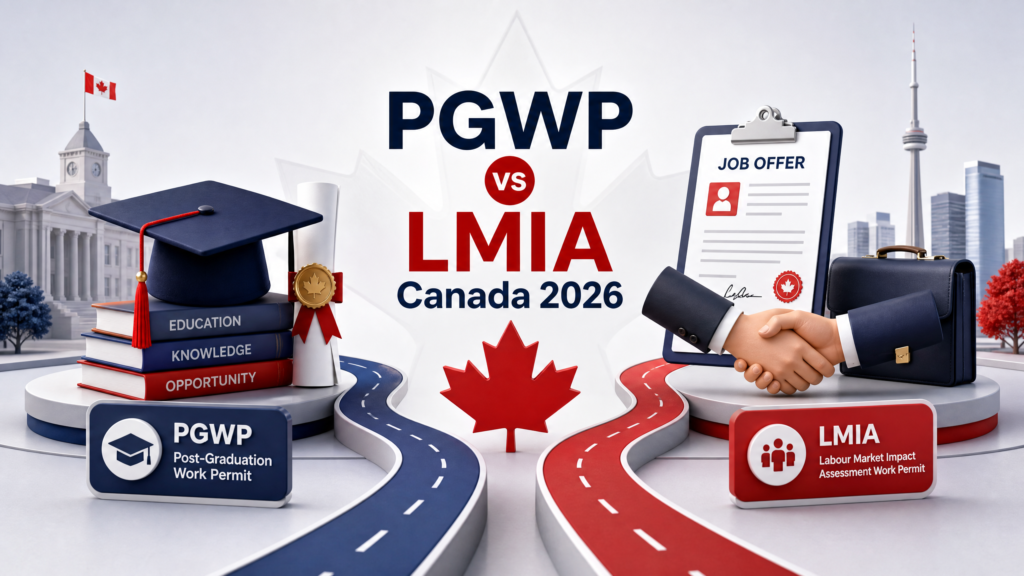
Understanding PGWP vs LMIA Canada 2026 differences is important because both pathways lead to work opportunities, but they function in very different ways.
Choosing the right path depends on your situation, employer, and long-term immigration goals.
What Is a PGWP?
A Post Graduation Work Permit allows eligible international students who have completed a program at a designated Canadian institution to work in Canada.
Key features include:
- Open work permit (no employer restriction)
- Based on completed education in Canada
- No job offer required to apply
- Valid for a limited period depending on program length
It is often the first work permit many graduates receive after studies.
What Is an LMIA Work Permit?
An LMIA-based work permit is employer-specific. This means:
- You must have a job offer
- Your employer must apply for LMIA approval
- The employer must prove no Canadian can fill the role
- Your work permit is tied to that employer
This makes it more structured and job-dependent compared to PGWP.
PGWP vs LMIA: Key Differences
Understanding PGWP vs LMIA Canada 2026 becomes easier when comparing both side by side:
- PGWP is open, LMIA is employer-specific
- PGWP is based on education, LMIA is based on job offer
- PGWP does not require employer involvement, LMIA requires employer application
- PGWP is usually the first step after graduation, LMIA is often used for longer-term employment
Each serves a different purpose in the immigration system.
Which One Is Easier to Get?
PGWP is generally considered easier because:
- No employer sponsorship is required
- No job offer is needed at the start
- It is based on completed studies
LMIA work permits can be more complex because employers must justify hiring a foreign worker.
Can PGWP Lead to LMIA or PR?
Yes. Many graduates use PGWP as a stepping stone.
A common pathway is:
PGWP → Work experience → Employer support → LMIA or PR pathway
This is why PGWP is often seen as a flexible starting point.
Common Mistakes Students Make
Many PGWP vs LMIA Canada 2026 misunderstandings come from poor information.
Common mistakes include:
- Assuming LMIA is always required after graduation
- Ignoring PGWP eligibility
- Relying on incorrect online advice
- Not planning long-term immigration strategy
Clear understanding helps avoid wrong decisions.
Which Option Is Better?
Neither option is universally “better.”
PGWP is ideal for:
- New graduates
- Those without job offers yet
- People building experience
LMIA is ideal for:
- Workers with employer sponsorship
- Long-term job arrangements
- Specific skilled positions
The right choice depends on personal circumstances.
Final Thoughts
Understanding PGWP vs LMIA Canada 2026 helps international graduates make informed decisions about their future.
PGWP offers flexibility after graduation, while LMIA depends on employer sponsorship and job availability.
Both can eventually support long-term immigration goals if used strategically.
Need Help Choosing the Right Path?
At Worldbridge Immigration, we help students:
- Understand work permit options
- Choose the right immigration pathway
- Avoid application mistakes
- Plan for permanent residency
Contact Worldbridge Immigration today to get started.