Canada’s international education sector continues to play a vital role in economic growth, cultural diversity, and talent attraction. However, to ensure sustainable growth and address pressures on housing, healthcare, and infrastructure, the government maintains a cap on study permits under the 2026–2028 Immigration Levels Plan. In November 2025, Immigration, Refugees and Citizenship Canada (IRCC) released detailed provincial and territorial allocations for 2026, confirming the framework first introduced in 2024.
Key Figures for 2026
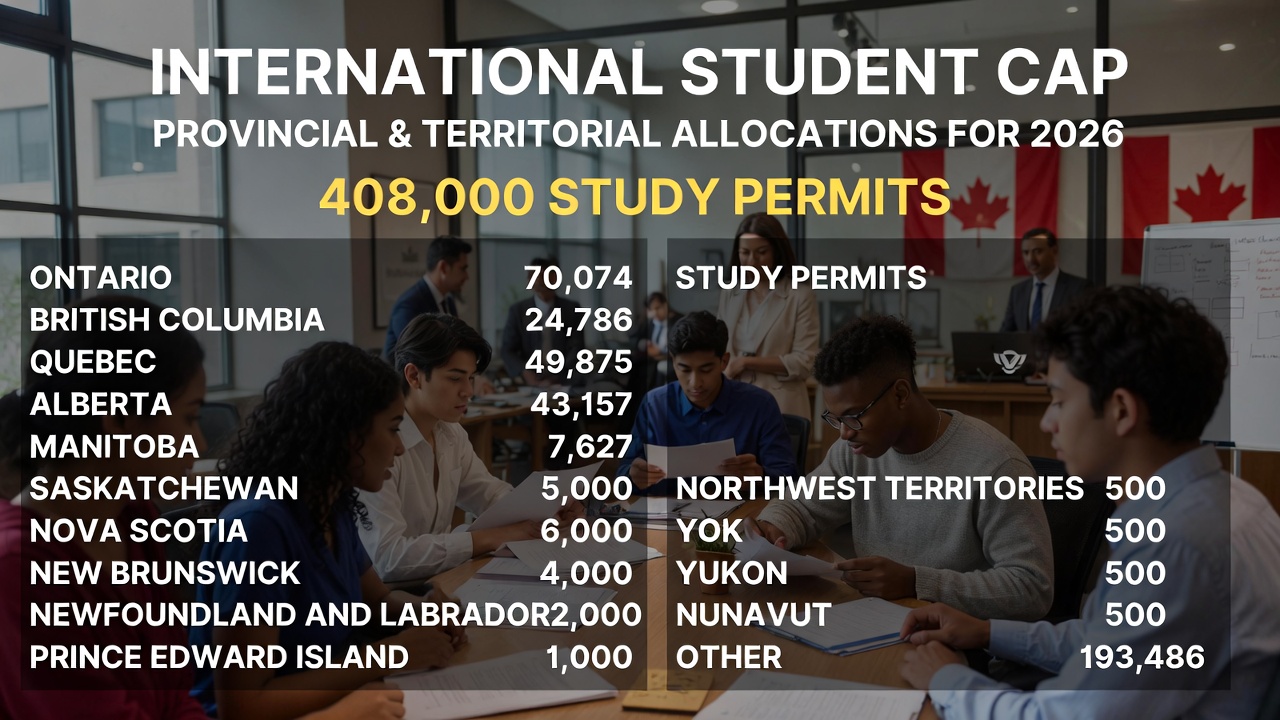
IRCC expects to issue up to 408,000 study permits in total during the year:
- 155,000 for newly arriving international students (new study permit issuances).
- 253,000 for extensions of existing permits (for students already in Canada renewing or continuing studies).
This represents a 7% reduction from the 2025 target (437,000) and a 16% drop from 2024 (485,000), aligning with the plan to reduce temporary residents to below 5% of Canada’s population by 2027.
Of the 155,000 new arrival permits, approximately 180,000 are targeted for students requiring a Provincial Attestation Letter (PAL) or Territorial Attestation Letter (TAL) the key mechanism for enforcing the cap. The remaining portion includes exemptions (e.g., master’s and doctoral students at public designated learning institutions (DLIs), K-12 students, and certain vulnerable groups).
To account for typical refusal rates (historically around 40–50%), IRCC has allocated 309,670 study permit application spaces for PAL/TAL-required students in 2026. Provinces and territories issue PAL/TALs to eligible applicants, and once issued, the application enters IRCC’s processing queue.
How Allocations Are Distributed
Allocations are based primarily on provincial/territorial population size and adjusted using historical study permit approval rates (from 2024–2025 data). This ensures a balanced distribution while recognizing regional differences in demand and processing outcomes.
Here are the main provincial and territorial allocations for PAL/TAL-required study permit targets (expected issuances) and application spaces:
- Ontario: Largest share — 70,074 expected permits (104,780 application spaces)
- Quebec: 39,474 expected permits
- British Columbia: 24,786 expected permits (32,596 application spaces)
- Alberta: 21,582 expected permits (32,271 application spaces)
- Saskatchewan: 5,436 expected permits
- Manitoba: 6,534 expected permits (11,196 application spaces)
- Nova Scotia: 4,680 expected permits (8,480 application spaces)
- New Brunswick: 3,726 expected permits (8,004 application spaces)
- Newfoundland and Labrador: 2,358 expected permits (5,507 application spaces)
- Prince Edward Island: 774 expected permits (1,376 application spaces)
- Northwest Territories: 198 expected permits (785 application spaces)
- Yukon: 198 expected permits
- Nunavut: Minimal or zero allocation (no designated learning institutions currently)
Note: These are approximate figures based on IRCC’s November 2025 announcement. Exact numbers may vary slightly depending on final approval rates and demand.
Important Exemptions and Changes in 2026
- Master’s and doctoral students at public DLIs are exempt from the PAL/TAL requirement starting January 1, 2026 (previously limited exemptions).
- K-12 (primary and secondary) students, certain short-term programs, and vulnerable cohorts (e.g., refugees) are generally exempt from the cap.
- PAL/TALs issued in 2025 remain valid into 2026 under specific conditions, but new applications must use 2026 allocations.
What This Means for Prospective Students
The reduced cap and provincial allocations make competition fiercer, especially in popular destinations like Ontario, British Columbia, and Quebec. Students should:
- Apply early to secure a PAL/TAL from their chosen province.
- Target programs at public institutions (especially graduate-level) for exemption advantages.
- Consider less-saturated provinces or territories with available spaces (e.g., Atlantic provinces or Prairie regions).
- Ensure strong applications — high refusal rates mean incomplete or weak files are more likely to be rejected.
For many international students, a Canadian study permit serves as the first step toward permanent residency through pathways like the Canadian Experience Class (CEC), Post-Graduation Work Permit (PGWP) transitions, or Provincial Nominee Programs (PNPs). Early planning is essential in this more regulated environment.
Worldbridge Immigration specializes in helping international students, recent graduates, and their families navigate these changes. Whether you’re applying for a study permit, planning your PGWP strategy, or aiming to transition to permanent residence via Express Entry or a PNP, our Regulated Canadian Immigration Consultants (RCICs) provide personalized guidance.
Ready to take the next step? Book a free eligibility and strategy consultation with Worldbridge Immigration today. We’ll review your profile, explain your realistic options under the 2026 rules, and help you build a clear plan — no obligation, no pressure.
Let Worldbridge Immigration Services be your guide to a successful future in Canada
Contact us:
Website: www.theworldbridge.ca
Email: info@theworldbridge.ca
Phone/WhatsApp: +1-416-727-7766
Social media: @worldbridgeHQ