
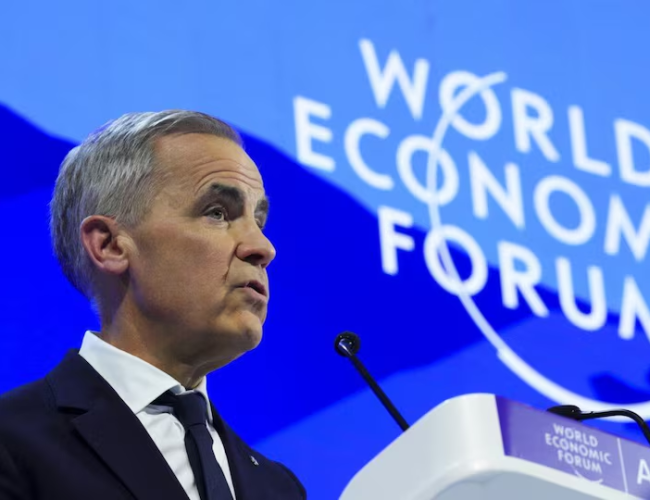
When Canada’s Prime Minister Mark Carney addressed the World Economic Forum in Davos last week, his message was unmistakable and deeply consequential for countries like ours. The familiar rules-based international order, he argued, is no longer holding. What is emerging is not a temporary disruption, but a new global reality defined by intensifying power rivalries, fractured alliances, and economic coercion.
Carney did not present this as an abstract geopolitical theory. He framed it as a practical challenge for middle powers. “We are in the midst of a rupture, not a transition,” he said. “The rules-based order is fading. The strong do what they can, and the weak suffer what they must.” For Canada, this was not a distant warning. It was a call to think clearly about how we build strength at home in a far more competitive world.

Adapting to this reality will require more than diplomatic signalling or trade diversification. It demands a serious re-examination of the foundations of Canada’s economic resilience and national capacity. Central to that foundation is human capital. In a world where supply chains can be disrupted overnight and alliances can shift without warning, the ability to attract, retain, and integrate people with the skills we need becomes a strategic asset.
Immigration, in this context, cannot be treated as a peripheral policy file. It is not simply about population growth or humanitarian obligation. It is about competitive advantage.
Carney urged middle powers to pursue what he called “values-based realism,” aligning national interests with democratic principles. Canada is well positioned to do so. We have strong institutions, a pluralistic society, vast land, and a diversified economy. Yet we also face persistent labour shortages, an aging population, and demographic trends that will not reverse on their own. Health care, advanced manufacturing, logistics, technology, agriculture, and community services are already under strain. These are not cyclical gaps. They reflect structural realities shared across much of the OECD.
In this environment, immigration must be understood as a core element of national strategy. Countries that manage human capital well will be better positioned to innovate, increase productivity, and sustain economic sovereignty. Those that fail to do so will find their options narrowing, regardless of their natural resources or historical advantages.
This is where Canada’s immigration system must evolve. Public debate remains overly focused on intake numbers. But arrival alone does not equal success. Outcomes do. A strategic approach prioritizes alignment between skills and labour demand, timely credential recognition, and early support that allows newcomers to contribute fully and quickly in their professions and communities.
“The real challenge, and opportunity, is removing the barriers that prevent contribution,” Carney’s broader framework suggests. Immigration systems, like global institutions, must be designed to function as described, not as hoped.
International students illustrate both the promise and the risk of getting this wrong. They arrive already trained in Canadian institutions, familiar with our systems, and often eager to stay and build their futures here. Yet too many encounter unclear or shifting pathways from study to work or from work to permanent residence. In a global competition for talent, such friction is not merely inefficient. It is self-defeating.
Carney’s geopolitical framing reinforces this point. In a world where economic integration can be weaponized and supply chains disrupted by political pressure, resilience depends on domestic capacity. Immigration, when designed strategically, strengthens that capacity. It supports entrepreneurship, fills critical roles, revitalizes communities beyond major urban centres, and sustains the tax base that underpins public services.
Canada is a vast country with a relatively small population. That reality has always shaped our development. Strategic immigration supports population growth where it is needed, contributes to regional renewal, and strengthens social cohesion when paired with effective integration. This is not growth for its own sake. It is growth that reinforces stability and shared prosperity.
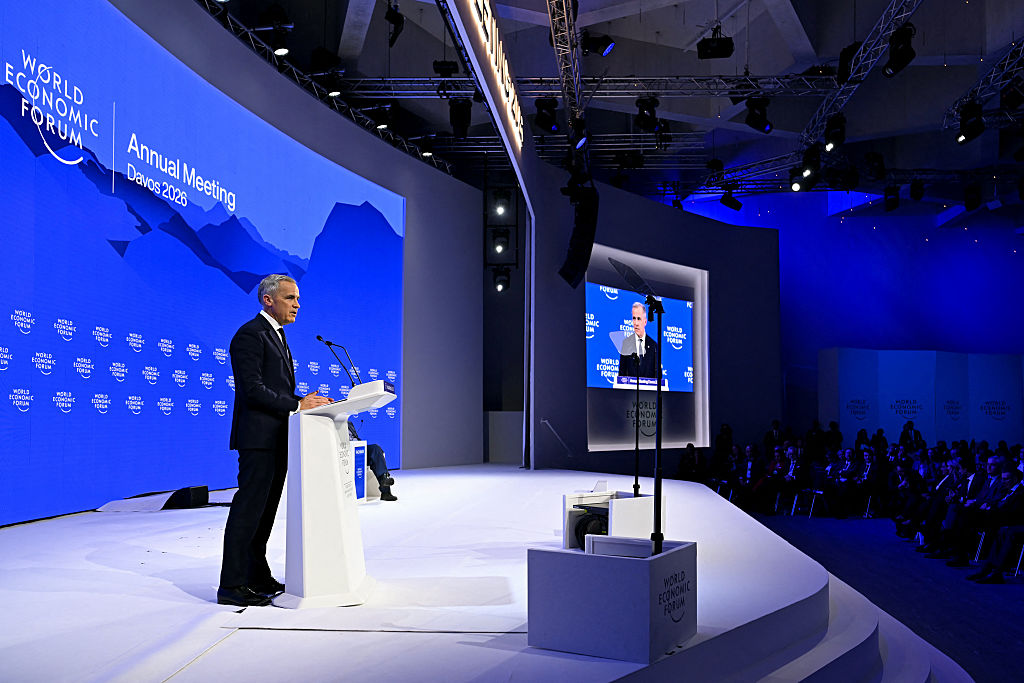
Carney also emphasized that values still matter. In a fragmented world, countries that remain open, inclusive, and predictable are more attractive to global talent. Immigration policies that support settlement, belonging, and contribution enhance Canada’s economic competitiveness as much as they reflect our democratic values. Soft power, in this sense, is inseparable from human capital strategy.
The question, then, is no longer whether Canada should welcome immigrants. Demographic reality has already answered that. The real question is whether we are prepared to design an immigration system that matches the moment we are in.
Carney’s Davos speech described a world that has moved beyond comfortable assumptions. Canada now faces a similar choice. We can cling to old frameworks and hope they still work, or we can adapt with clarity and confidence.
If Canada is to thrive in the new world order Carney described, immigration must be part of our strategic response. Not simply as an expression of compassion, and not merely as a tool for growth, but as a deliberate investment in the people and capacities that will shape our future.
Immigration is not charity. It is strategy.
Sources
- “Principled and Pragmatic: Canada’s Path,” Special Address by Prime Minister Mark Carney, World Economic Forum Annual Meeting, Davos, January 2026 (Government of Canada transcript).
- Government of Canada demographic projections and labour market data.
- OECD analysis on aging populations, labour shortages, and global competition for talent.